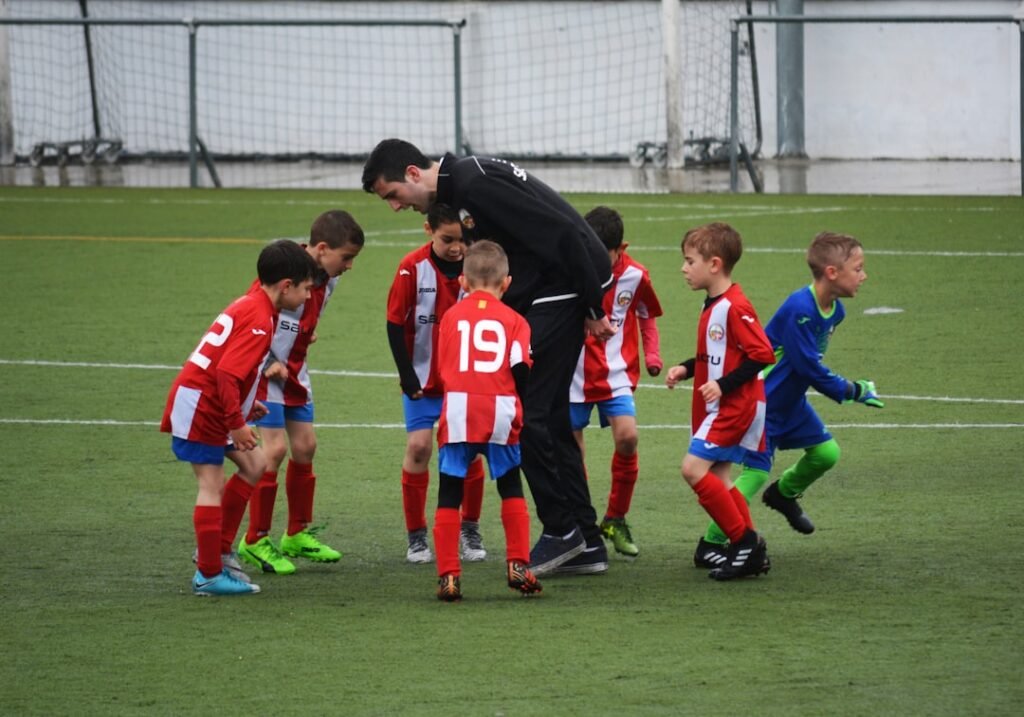
The opposition center midfielder plays a pass past your midfield line. The opposition center forward drops in, receives the ball in the middle, in front of your back line, and turns. Your center backs are backing off toward the penalty area. Your central midfielders are still running toward the player who played the pass. Two passes later the opposition has a shot. You have probably seen a version of this more than once this season, and it is exactly the sort of situation that can be displayed visually on a soccer tactics board.
If your team keeps letting the opposition turn in front of your back line, it could be a problem at the team level or the individual level. For example, there may be a misunderstanding of the overall Team Intention or team tactical principle, or a misunderstanding of the player’s Individual Intention or role within the team tactical principle. From the touchline the two can look the same. On a football tactics board, with your players gathered around it, they usually look very different, and that difference tells you which conversation to have. It is one of the more useful things youth soccer coaching tools can do: hold a situation still long enough for your players to see it.
Closing The Middle In Front Of Your Back Line: What Your Team Is Trying To Do
When your team is defending, the Team Task is to prevent chances to score. Teams that use Team Intentions break that task into a priority order: close the middle in front of the front line, then close the middle in front of the midfield line, then close the middle in front of the back line, and finally close the middle behind the back line. The team aims for the highest one it can. When the opposition plays past one line, the next Team Intention in the order becomes the one your players are working on.
In the situation above, the opposition has played past your front line and your midfield line. The Team Intention your team is now working on is to close the middle in front of the back line. Seen from the opposition’s side, that same area is the space behind your midfield line, and an opposition player who receives there facing your goal often has several options: a shot, a pass into the space behind your back line, or a dribble at your center backs. That is why the middle in front of your back line tends to matter so much once the ball has been played past your midfield line.
Here is where a team-level problem shows itself. If your players do not share which Team Intention the team is working on, you get the split from the opening. Your central midfielders keep running toward the player who played the pass, as if the team were still closing the middle in front of the midfield line. Your center backs drop toward the penalty area, as if the team had already moved on to closing the middle behind the back line. Each player is doing something they could explain if you asked them about it. They are simply working on two different Team Intentions, and the middle in front of your back line is the space left between them.
Some teams organize the same idea with team tactical principles instead of Team Intentions. A team might use the principle “if the opponent exploits space behind you, sprint back.” For your central midfielders in this situation, that is the whole idea in one sentence: the opposition has exploited the space behind them, so your central midfielders sprint back. If your team uses a principle like that and your central midfielders are still running toward the ball, the question is the same as before. Do your players share the principle, and do they recognize the situation it is for?
Team Level Or Individual Level? Finding Out With A Football Coaching Board
If your players do share the Team Intention or team tactical principle, the problem may sit at the individual level instead. Each player’s Individual Intention is their role within what the team is trying to do, and roles differ from team to team. On one team the nearest center back’s role may be to step into the space in front of the back line and pressure the opposition center forward as they receive, while the other center back and the fullback on that side narrow to cover the space behind. On another team the center backs’ role may be to hold the back line while the central midfielders sprint back into that space. Both can work. What tends not to work is a team where the center back believes closing that space is the central midfielder’s role and the central midfielder believes it is the center back’s.
This is also where it matters which player you correct. The center back who gets turned is the most visible player in the situation, so they are usually the one who hears about it. But if your team asks the center backs to hold the back line and asks the central midfielders to recover into the space in front of it, the center back made the right decision. Correcting a player for the right decision tends to make them hesitate the next time, and a hesitating center back tends to leave more space, not less. In that case, the player whose role needs the conversation is more likely the central midfielder.
A board makes the split visible. On the front side, a full 11v11 pitch, place however many magnets match the shape you actually play, for both teams. The horizontal thirds and central spaces are drawn to exact proportional measurements, so the middle in front of your back line on the board sits in the same proportion of the pitch your players defend on match day. That is the practical value of a soccer tactics board built to proportional scale: the distances your players see on the board match the distances they defend. Use the dry-erase marker to draw your midfield line and your back line, then place the opposition center forward’s magnet in the middle, between the two lines. Now ask two questions: which space is our team trying to close, and whose role is it to close it? If your players give different answers to the first question, you are probably looking at a team-level problem. If they agree on the first and disagree on the second, the problem is more likely at the individual level.
A Coaching Tip When Using A Soccer Tactics Board With Magnets: Let Each Player Move Their Own Magnet
When you set this up with your players, resist moving the magnets yourself. Set the picture at the point the opposition center midfielder plays the pass past your midfield line, then hand the board over. Each player involved in the situation moves their own numbered magnet to where they would go and says out loud which space they are closing. Start with the central midfielders, then the center backs, then the fullbacks.
You learn a lot in about a minute. If your central midfielder moves their magnet toward the ball and your center back moves theirs toward the penalty spot, you have found the team-level split without saying a word, and your players have found it too. If your players all name the same space but both center backs step into it while neither fullback narrows to cover the space behind, the roles need clarifying. Either way, your players have explained the situation in their own words, which tends to stay with them far longer than an instruction from the touchline.
The board is never a replacement for the work that needs to be done out on the field. The board recreates situational moments that can be displayed to give that same picture to players. When a similar situation comes up in your next session, your central midfielders have already seen where the space was, and they have already said whose role it is to close it.
Defending Set Pieces With A Dual Sided Soccer Tactics Board
The same space shows up when you are defending set pieces. When your team clears a corner kick, the ball often drops around the edge of the penalty area, in the middle, in front of your back line, and an opposition player positioned there may reach it first. Which of your players covers that space is a role, and it is far easier to settle before the corner is taken than after the shot.
The back side of the Vizzionboard is a half-pitch, so a whole penalty area fits at true proportional scale. Like the front side, the back side is magnetic and dry-erase, so you can place magnets and draw on it in the same session. The magnets hold your set piece routine, including which of your players covers the edge of the penalty area, while you draw where a cleared ball tends to drop. Wipe the drawn lines and redraw them for each variation: an inswinging corner, an outswinging corner, a short corner. The magnets stay where they are, and your players see how the area where the ball may drop changes with each one. Used as a soccer set piece board, the back side gives your defending set piece routines the same language your players use in open play, and it works just as well when you turn to your attacking corner kick routines.
Scaling The Idea To 7v7 And 9v9
In 11v11 you might talk with your players about closing the middle in front of the back line and the role of each center back and central midfielder. In 7v7 and 9v9, younger players often need the same idea in simpler language, something like “if they get past our midfield, protect the middle in front of our defenders.” The number of magnets in each line changes with the format and with the shape you play, but the middle in front of your back line is still there, and it is still a space an opposition player will often try to receive in.
Younger players often struggle to retain a picture based on what is said verbally, which is why a board tends to help most at these ages. Ten seconds of moving magnets can show what three minutes of explanation at halftime often cannot.
Soccer Club Coaching Equipment That Keeps The Language The Same
If you are a director of coaching, this problem multiplies across your club. Your U10 coach says “track back,” your U13 coach says “drop in,” and your U16 coach says “close the middle in front of the back line.” A player moving up through your club hears three different instructions for the same situation and may reasonably think they are three different ideas. When each team works from the same Team Intention or team tactical principle, and shows it on the same board, the language a player learns at nine still means something at sixteen.
That is one reason some clubs give each of their teams the same soccer club coaching equipment rather than leaving each coach to improvise. Club pricing for the Vizzionboard starts at $47.99 per board for orders of 10 or more. See club pricing for the details. It is why the slogan is Built to Develop Champions, not because a board wins matches on its own, but because players who share the same picture tend to defend the same space together.
See The Space Before The Opposition Turns
The next time the opposition turns in front of your back line, before you correct the player nearest the ball, ask where the problem sits. Is it at the team level, or with a player’s role? Put the situation on the board, let your players move their own magnets, and the answer usually shows itself.
If you want a tactics board that is dual-sided, breaks the field into horizontal and vertical spaces, and fits into your backpack, take a look at the Vizzionboard. The front side is a full 11v11 pitch and the back side is a half-pitch, both magnetic and dry-erase, with 23 numbered positional magnets, a dry-erase marker and eraser, and a protective carry bag included. Shop the board here and start showing your players the space before the opposition finds it.
Built to Develop Champions.