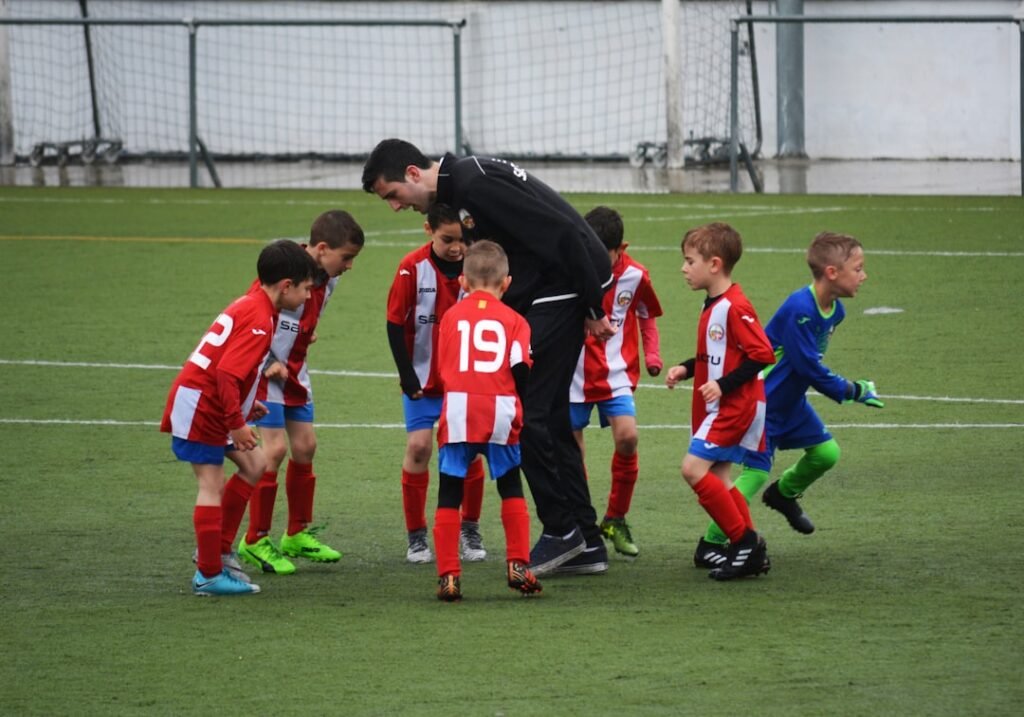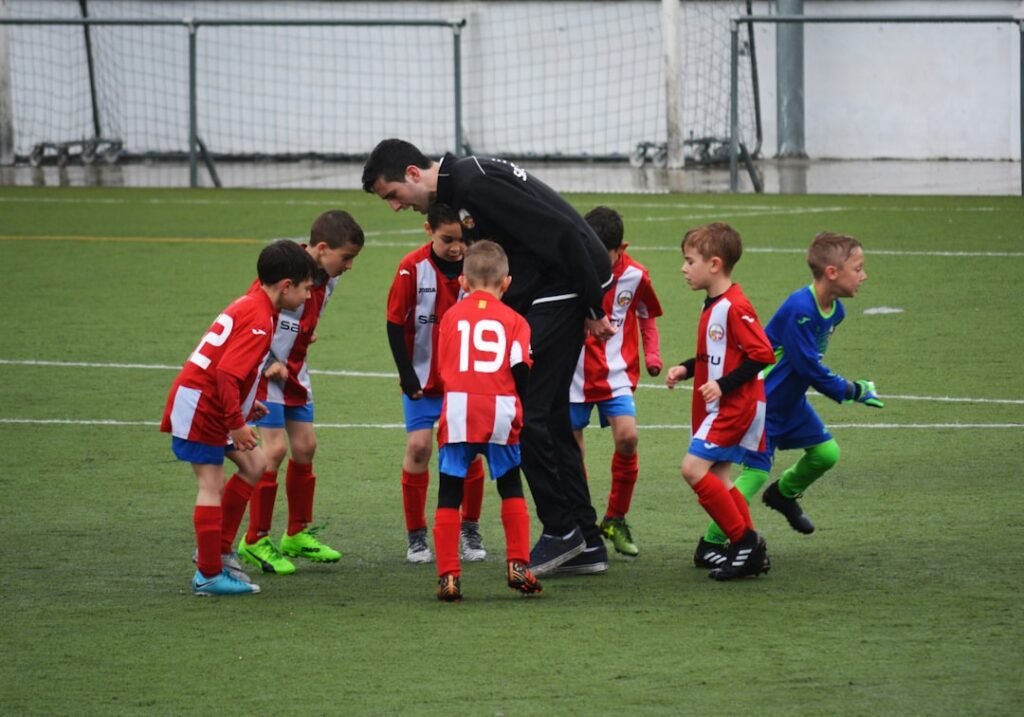
You’ve seen it a hundred times. The kid with the best first touch on the team, the one who can juggle in the parking lot before practice even starts, receives a simple pass in a match and completely freezes. Ball at his feet, three options open, and he either panics into a hurried pass backward or gets swallowed by the first defender who closes him down. Parents in the stands wince. You wince. And afterward you find yourself explaining, again, that this isn’t a technique problem — his touch was fine. It’s a decision-making problem, and no amount of extra ball-mastery reps in the driveway is going to fix it.
This is where most youth coaching gets stuck. We default to more technical repetition because it’s easy to coach and easy to measure. But the player development tools soccer coaches actually need aren’t more cone drills — they’re tools that train a player’s eyes and brain before the ball ever arrives. A soccer tactics board and a football tactics board session on the sideline can do more for a player’s decision speed in fifteen minutes than a full training session of isolated touches. The gap isn’t in the feet. It’s in what the player sees, and when.
Why Technically Gifted Players Still Freeze Under Pressure
A player who receives the ball without first checking their shoulder is playing blind by choice. They don’t yet know where the pressure is coming from, where the open teammate is, or how much space they actually have — so their brain defaults to the safest, slowest option. This is a scanning problem, not a skill problem, and it shows up constantly in players aged 10 through 16 regardless of how many private lessons they’ve had.
Good youth soccer coaching tools make this visible in a way words alone can’t. When you can physically move a magnet to show a player’s body shape at the moment the ball arrives — open hips versus a closed back — the lesson lands instantly. Players understand “scan before you receive” as an abstract instruction for years without it changing their game. They understand it in about ninety seconds when they see it modeled on a board in front of them.
Decision-Making Speeds Up the Closer a Player Gets to Goal
Here’s the piece that gets missed in a lot of youth coaching: the speed a decision needs to happen at isn’t constant across the pitch. A center back can take an extra half-second on the ball near their own goal. A striker receiving on the edge of the box does not have that half-second — the closer a player gets to the opposing goal, the faster and more direct their read has to be, because the cost of hesitation goes up and the window to act shrinks.
This is exactly the kind of concept that’s hard to teach verbally and easy to teach visually. A youth soccer player development board lets you walk a player through the same situation at three different distances from goal — deep in your own third, at midfield, and inside the attacking third — and show them, physically, why the same pass takes on a different urgency in each zone. Once a player feels that difference on a board, they start recognizing it in games without you having to shout instructions from the touchline.
Using a Soccer Tactics Board to Rehearse Decisions Before the Whistle
The reason a soccer tactics board works better than a whiteboard sketch or a verbal walkthrough is proportional accuracy. A Vizzionboard tactics board is built to true proportional scale, so when you show a player the horizontal thirds of the pitch or point out a half-space coaching board scenario, the spacing actually matches what they’ll see in a real match — not an approximation drawn freehand under pressure before kickoff.
Because the board is dual-sided and both surfaces are magnetic and dry-erase at once, you can set up 23 numbered magnets to mirror full 11v11 shape on the full-pitch side, then flip to the half-pitch side to isolate a single zone and draw directly on top of it with a marker — same session, no separate equipment. For older 11v11 teams, this is where you can get specific about half-space occupation and how it opens up the decision to play forward. For 7v7 and 9v9 groups, skip that language entirely and keep it simple: “open body, see the field, then decide” is plenty for that age group, and the board still makes the point without the jargon.
Club directors managing multiple age groups often ask how to keep this kind of decision-making language consistent across every team in the program. That consistency is exactly what a shared visual system solves — worth a look at club pricing if you’re outfitting more than one team.
A Training Exercise That Builds Scanning Habits
Try this the next time you want to build decision-making without turning it into a lecture. Format doesn’t matter here — it works at 7v7, 9v9, or 11v11:
- Set up a 4v2 possession box in a grid roughly 15×15 yards, with the two defenders inside and four attackers on the perimeter.
- Add a scanning rule: before receiving, every attacker must physically turn their head to check over their shoulder — no exceptions, even on a simple pass. Call out any player who receives without scanning first.
- Progress it: once the group is comfortable, add a neutral player inside to increase passing options and force faster reads.
- Debrief on the board: after five minutes, pull the group over and recreate two or three real moments from the exercise using magnets, asking the player involved to explain what they saw and why they chose that option.
That last step is the one most coaches skip, and it’s the one that actually builds the habit. A training exercise without a visual debrief teaches a player’s feet. A training exercise with one teaches a player’s brain — and that’s the difference that shows up in games, not just in practice.
Building the Habit, Not Just the Skill
None of this replaces good technical and tactical coaching. A player still needs a clean first touch and the ability to strike a ball. But the soccer tactics board proportional scale advantage is that it trains the part of the game most sessions never touch directly: what a player sees, and how fast they act on it. Parents notice this shift fast — it’s the difference between a kid who “has good feet” and one who visibly reads the game a step ahead of it.
If you’re looking to build that habit into your own sessions, a soccer tactics board designed for exactly this kind of coaching — dual-sided, true to scale, built with the visual language players actually understand — is one of the more useful soccer club coaching equipment investments you can make this season. See the board and get started at the Vizzionboard shop.