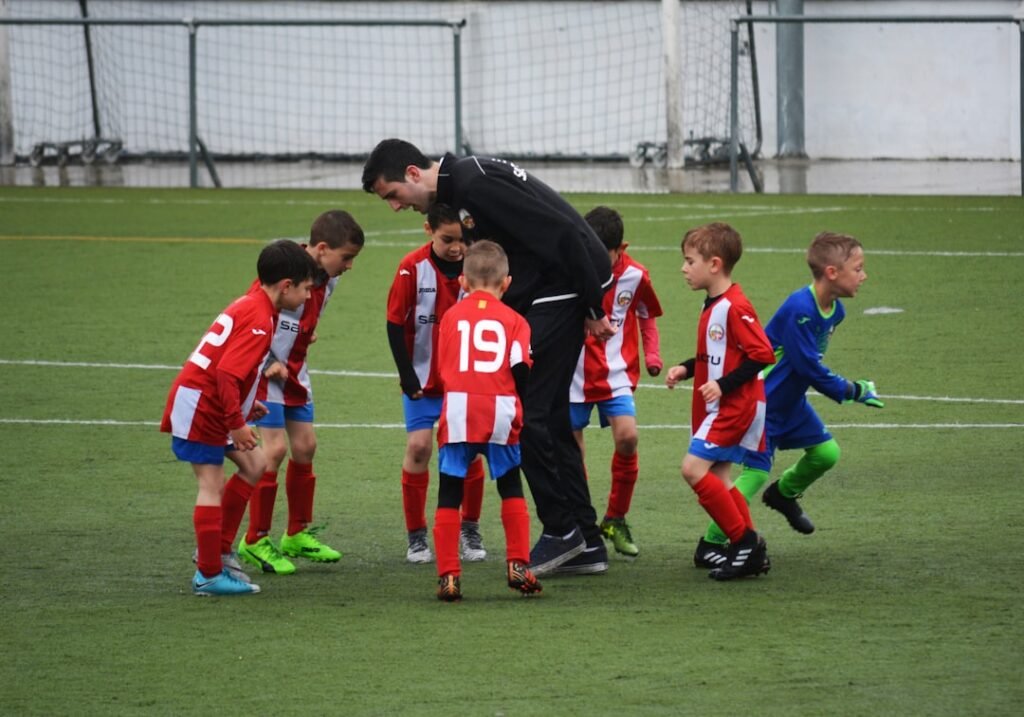
Watch fifteen minutes of almost any youth match and you’ll see it: the ball gets stuck in a ten-yard central corridor while both wingers stand along the touchline, hands on hips, completely out of the game. You’ve drawn the width on a whiteboard a dozen times. You’ve shouted “spread out” from the touchline until your voice gives out. And still, by the second half, everyone is back in the same crowded strip of grass, trading fifty-fifty tackles while two open lanes sit empty on either side. It isn’t a discipline problem. It’s that most youth soccer coaching tools never actually show a player what width looks like from the inside of a match — they just describe it.
Why Every Youth Match Collapses Into the Same Ten Yards
Kids chase the ball. That’s not a coaching failure, it’s basic instinct — the ball is where the excitement is, so bodies drift toward it from every direction until the central corridor is jammed with six or seven players fighting for a yard of space. Defenders love this. A packed middle third is the easiest thing in the world to defend, because every passing lane is congested and every touch invites immediate pressure from two directions at once.
The fix coaches usually reach for is a verbal one — “stretch the field,” “hold your width” — and it works for about four minutes before the game pulls everyone back toward the ball again. That’s because width isn’t really a positioning instruction. It’s a spatial relationship between the wide zones and the central corridor, and most players have never seen that relationship drawn out clearly enough to carry it from the sideline onto the pitch.
The Wide Zones Coaches Forget to Coach
Here’s what gets missed: teaching width isn’t just telling a winger to stand near the touchline. A winger standing wide but flat-footed, facing the sideline, isn’t actually usable — they’re just far away. Real width means the wide zone stays occupied by a player who is angled to receive, ready to attack the space in front of them the moment the ball arrives, not a player parked there as scenery.
The same logic applies to fullbacks. In an 11v11 team, an overlapping fullback who times their run into the wide zone can pull an entire opposing line out of shape and reopen the central corridor that was jammed a moment earlier. At 7v7 and 9v9, you won’t coach an overlapping run with that kind of language — it’s too much for the age group — but the underlying idea still works: “when the middle is crowded, someone has to go find the open grass on the side.” Said that simply, even your youngest players get it.
This is where a lot of player development tools soccer coaches use fall short. A cone grid shows a static shape. It doesn’t show the moment a central pass gets pressured and a switch to the wide zone turns a stuck possession into a clean run at goal. Players need to see that sequence, not just the end positions.
A Soccer Tactics Board With Magnets Makes Width Visible
This is exactly the gap the Vizzionboard soccer tactics board is built to close. A football tactics board built to true proportional scale means the wide zones on the board are the same relative distance from the central corridor as they are on a real pitch — not an approximation sketched freehand on a whiteboard where “wide” and “central” end up looking about the same size. When a player sees a magnet move from a crowded central corridor into real, proportionally accurate space out wide, the value of that switch is obvious in a way words never quite manage.
Because a Vizzionboard dual sided soccer tactics board puts a full 11v11 pitch on one side and a half-pitch on the other, and both surfaces are magnetic and dry-erase at once, you can set the 23 numbered positional magnets to show a jammed central corridor on the full-pitch side, then draw directly over it with the marker to trace the exact passing lane that opens once a winger drops into the wide zone. Same session, no second whiteboard, no separate marker set — just one continuous coaching moment. It’s one of the more practical pieces of soccer club coaching equipment for this specific problem, because the board doesn’t just tell a player where to stand, it shows them why standing there matters.
Club directors juggling several age groups tend to ask the same question here: how do you keep this language about wide zones and the central corridor consistent across every team in the program, instead of every coach improvising their own version? A shared visual system on the sideline solves that automatically — worth a look at Vizzionboard’s club pricing if you’re outfitting more than one team this season.
A Training Exercise: The Switch-to-Score Pattern
Try this the next time your team is bunching centrally in training. Format doesn’t matter — it works at 7v7, 9v9, or 11v11:
- Set up three zones across the width of your training area — a wide zone on each side and a central corridor in the middle, marked with cones or lines.
- Start every possession in the central corridor with a small-sided group (4v4 works well) and let the defense apply pressure until the middle gets congested — it will, quickly.
- Add the rule: once pressure builds centrally, the ball must be switched into one of the wide zones before an attacker can advance toward goal. No shortcuts through the middle once the defense collapses in.
- Break it down on the board: pull the group over afterward and recreate two or three real moments with magnets, asking the player who made the switch what they saw in the central corridor that told them it was time to go wide.
That last step is what actually builds the habit. Players who can explain the read on a training exercise start recognizing the same picture in a real match — the crowded middle, the open wide zone — without you having to call it out from the touchline every time.
Turning Width Into a Habit, Not a Reminder
None of this replaces good communication or decision making. A team still has to be positioned correctly and skilled enough to execute the switch under pressure. But teaching players to actually read the relationship between the central corridor and the wide zones — rather than just hearing “spread out” for the hundredth time — is what turns width from a sideline reminder into something the team does on instinct.
If you’re looking to build that read into your own sessions, a soccer coach board designed specifically for this kind of visual teaching — dual-sided, backed by a US design patent for its true-to-scale accuracy — is one of the more useful investments you can make before the next round of matches. See the board and get started at the Vizzionboard shop.