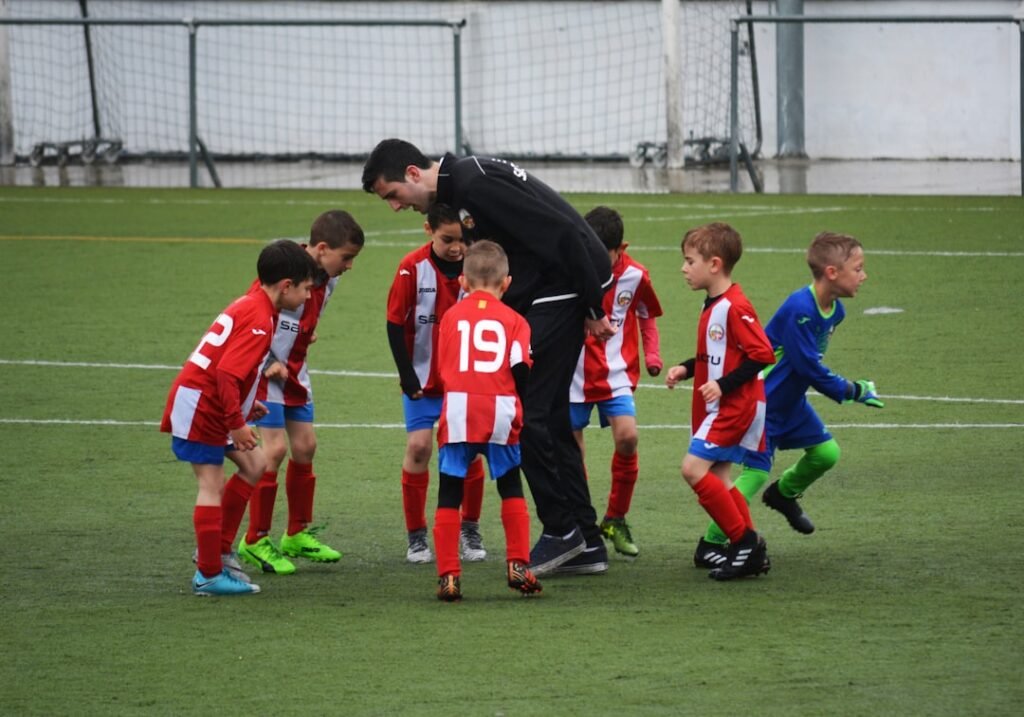
Your No. 9 is brilliant in the build-up play for eighty-five yards of the pitch. She checks to feet in midfield, plays a precise one-touch combination with a teammate, and reads pressure like a pro. Then the ball arrives in the last 30 yards from goal and something changes. The same player that just made five good decisions in a row suddenly takes a heavy touch, looks up twice, and lets a covering defender recover. It isn’t a confidence problem, and it isn’t a finishing problem. Nobody ever taught her that the speed of a decision is dictated by the space and time she has — and that’s exactly the sort of situation that can be displayed visually on a soccer tactics board.
Why Good Decisions in Midfield Third Turn Into Hesitation in the Attacking Third
Coaches tend to treat decision-making as one skill that a player either has or doesn’t. In practice, the standard for a good decision isn’t constant across the pitch — as a player gets closer to goal, the spaces they position in can become very compact, making it more difficult to exploit the space behind the opposition back line. A player receiving near the halfway line might have more space around them, and space is time — time to take a settling touch, lift their head, and pick from several options. A player receiving in the last 30 yards has almost none of it, because a goalkeeper and a recovering back line are closing the space in real time. The role itself often changes: read the situation, make the best possible decision, execute that decision. What changes is the pressure the opposition applies. Close to goal, the correct decision might be the earliest one, the most direct one, or the fastest one — not because the game asks more of the player there, but because the situation might give them far less space and far less time to execute.
Most players are never shown that the space their team is trying to attack moves as they advance up the pitch. In the Defensive Third or Midfield Third they might be looking to exploit the space behind the opposition midfield line, where there might be enough room to take a touch, lift their head, and then make their decision. In the last 30 yards the space that matters most is the one behind the opposition back line — and that is the space the opposition works hardest to protect. Same player, same intention to progress, a very different picture in front of them.
The Space a Team Attacks Moves Up the Pitch
There is an order to it, and it rarely changes. The most valuable space is the one behind the opposition back line: get in there and a player is facing goal with only the goalkeeper left to beat. If that is shut, the next best space is behind the opposition midfield line. If that is closed too, it is behind their front line. And when all three are unavailable, the space to exploit is in front of their front line — a team still has possession, but has not progressed yet.
What changes as a team moves forward is not the order but the availability. In the Midfield Third, two or three of those spaces are often available at once, which is why a central midfielder there can afford to look up, weigh the options, and still pick a good one. By the time the ball reaches the Attacking Third, the opposition has usually closed the middle in front of their own back line, so the highest-value space is also the most defended. That is the squeeze: the space worth the most is the one with the least room and the least time to use it.
Advanced language helps here at 11v11 — asking a winger to position out wide while a fullback underlaps is a reasonable instruction for a 15-year-old. At 7v7 and 9v9 the same idea needs simpler words: is there grass behind their last defender, and can we get someone into it? The concept is identical. Only the vocabulary should change with the age group, which is why youth soccer coaching tools that show the pitch honestly matter more than any particular phrase.
Player Development Tools Soccer Coaches Can Use to Show Which Space Is Open
The practical version is a single question, asked before the ball arrives rather than after: which space is actually open right now? A player who can answer that is no longer guessing, because their role in that moment follows directly from the answer.
Take a striker that is attacking and is positioned between two center backs. If one of those center backs steps up and leaves space behind, her role is straightforward — spin off the shoulder and exploit that space, because the most valuable option is available. If in that same situation the center backs drop and close the middle in front of their goalkeeper, the space behind them may no longer be an option, and her role changes: check into the pocket of space in front of them, now exploiting the space behind the opposition midfield line, so the team can continue progressing the ball forward. Same player, same possession, perhaps ten seconds apart, and two completely different responsibilities.
Most hesitation near goal is miscommunication. The player is still making the run that was right ten seconds ago, or checking to feet when the space behind had just opened up. It looks like indecision from the touchline. It is more often a player reading an old picture.
A soccer coach board earns its place in this conversation because it lets a coach freeze that picture, move the lines, and ask the question before it ever happens live and under pressure. Video shows what already happened. A board lets a coach show what could happen next, then reset the shape and run it again from a slightly different starting position until the read starts to come naturally. Coaches searching for the best soccer tactics board for coaches are usually asking a football question rather than an equipment one: can it show the lines and the spaces between them honestly?
Why a Proportional Soccer Tactics Board With Magnets Makes the Lines Visible
This is the kind of moment Vizzionboard was built to make visible. Because the board is built to true proportional scale, the space between a back line and a midfield line on the board can be displayed the same way the space appears on a real pitch — so when a coach shows a player why the space behind the back line is tighter in the last 30 yards than the space behind the midfield line was at halfway, the distances require different solutions that a coach can walk through easily. Both sides are magnetic and dry-erase, so in the same session a coach can set out a defending shape — seven, nine, or eleven magnets from the set of 23, depending on the format — then draw the run and the pass through or over the top with a marker without swapping equipment or wiping the shape away mid-explanation.
On Vizzionboard, the front side is a full 11v11 pitch, which is where the relationship between all three opposition lines and the spaces between them is easiest to see. The back side is a dedicated half-pitch, built for the zoomed-in version — set a back line tight around the box, place the attacking pattern, and walk a player through the read without the rest of the pitch crowding the picture. Two different surfaces for two genuinely different moments in a session, which is the practical case for a dual sided soccer tactics board.
Diagramming Corner Kick Routines and Set Pieces on the Half-Pitch
That half-pitch is also where set piece routines become straightforward to diagram, and set pieces carry more weight in the modern game than they used to. Corners, attacking free kicks, and long throws all happen inside a single penalty area, so a coach can place every runner and every player in the position they’ll occupy on match day, then draw the delivery, the near-post run, and the second-ball movement. That is what makes the half-pitch a practical soccer set piece board as well as a teaching surface. Corner kick routines tend to hold up better on match day when players have seen them laid out rather than only heard them described. Of course they need to be rehearsed on the field, but showing a visual on game day can be a very helpful reminder for young players.
For directors of coaching who want the same standard taught the same way in every age group, club pricing for 10+ boards makes it realistic to put the same teaching tool in front of every team in the club.
A Training Exercise for Reading Space Near Goal
Try this the next time you run an attacking training session in the attacking half. It works at 7v7, 9v9, or 11v11 — the number of defending lines is the only thing that changes:
- Decide on the team intention or intentions that you want to coach.
- Set the defending team up in lines: a front line, a midfield line, and a back line for 11v11. At 7v7 and 9v9, three lines are ideal, or two if numbers are low — a midfield line and a back line.
- Set up the attacking team: a front line, a midfield line, and a back line — again, three lines are ideal, or two if numbers are low.
- Set up pug goals or an endzone for the defending team to counter to. Pug goals can be used as a replacement for missing players.
- The game should flow naturally, and play can start with a coach passing into an attacking player. The attacking team attacks goal, and the defending team scores by winning possession and counter attacking into the pug goals or endzone, whichever was used.
- If the play goes out of bounds, play is resumed with the coach passing to an attacking player again. This gives repetition to the attacking players and presents the coach with many opportunities to show players which space to exploit and how they can position to exploit those spaces.
- Review on the board afterward. Display the magnets to the exact moment a player hesitated, and ask what space the team can exploit and what supporting positions teammates can take up to continue progressing the ball forward.
This should be the tactical part of a training session. Make sure to set up the attacking team with the system of play you intend on using, against the defending system you want them to build up against.
What Changes Once Players Can See the Lines
None of this asks a player to be more technical than they already are. It asks them to see which space is open, understand that their own role follows from that, and feel often enough how much less room there is to execute near goal that the adjustment starts to happen without a shout from the touchline.
That is often the difference between a team that struggles to accomplish team tasks and a team that consistently accomplishes their team tasks, because more of the players already know what team intentions to execute. See both sides of the Vizzionboard at vizzionboard.com/shop and start teaching your team to exploit and close spaces — not just react to the ball.