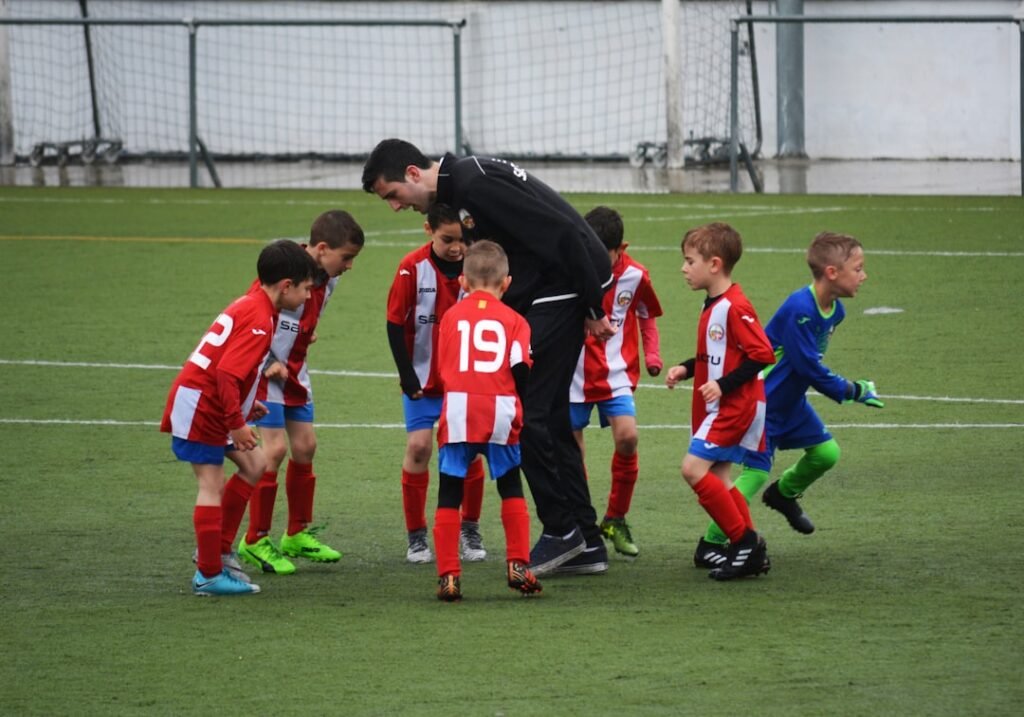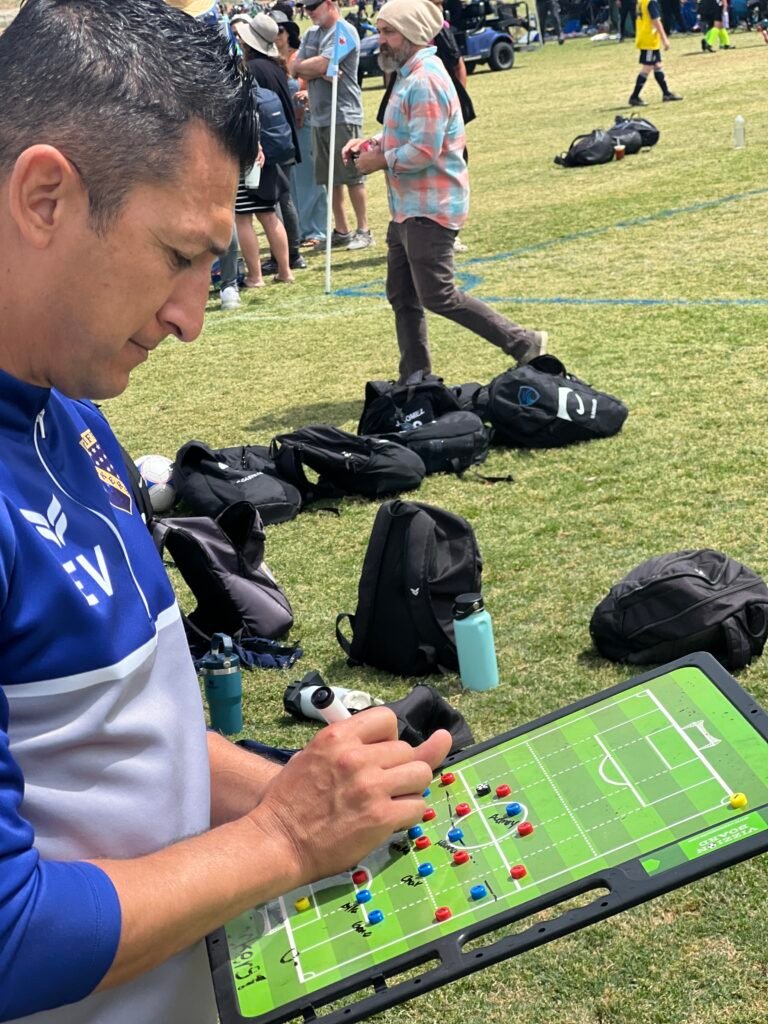
You gather the group after a rough first half. You’ve got ten minutes, maybe fifteen, but you can feel the attention start to drift after the first couple of sentences. You say ‘we need to hold our shape and close the middle behind the back line,’ and eleven heads nod. Then the second half starts and the same gap opens up again. The words were right. The picture never landed. That gap between what a coach says and what a player actually sees is the real problem a soccer tactics board is built to solve, and it’s the reason so many coaches end up shopping for one in the first place.
If you’re comparing options, the question worth asking isn’t just whether it looks professional on camera. It’s whether the board actually changes what a player understands about the game. That’s the lens we’ll use here — what collegiate, high school, and club coaches tend to look for once they’ve moved past the general idea of a soccer tactics board and into deciding which one earns a permanent spot in the coaching bag.
The Problem With Explaining Tactics Out Loud
Verbal instruction asks a player to build a mental picture from words alone, usually right after they’ve been sprinting. Younger players in particular struggle to hold onto a picture built only from words — by the third sentence of a positional explanation, most of the group has already lost the image you were describing. Older, more experienced players can often hold a verbal picture longer, but even then, a diagram tends to remove the guesswork. This is less about coaching skill and more about how people process spatial information: most players understand a shape faster when they can see it than when they can only hear it described.
That’s the case for youth soccer coaching tools that let a coach draw and point rather than only talk. A whiteboard session where you sketch the back four, mark where the wide players position, and trace the run you want isn’t a gimmick — it’s closing the gap between the coach’s mental model and the player’s.
What Coaches Actually Look for in a Soccer Coach Board
When you talk to coaches who’ve already been through this search — the ones asking what makes a best soccer tactics board for coaches at their level — a few criteria come up again and again, and they’re rarely about looks:
- Proportional accuracy. If the width of the penalty area or the depth of a defensive third isn’t drawn to scale, the spatial lesson taught on the board doesn’t transfer cleanly to the actual pitch. A soccer tactics board proportional scale matters more than most buyers expect going in.
- Enough surface to draw an attacking shape and a defending shape side by side, without erasing one to draw the other mid-explanation.
- A soccer tactics board with magnets that hold position while a coach talks — magnets that slide with a bumped table or a gust of wind on the sideline defeat the purpose.
- Durability that survives a full season of being tossed in a bag between two or three practices a week, which is the normal rhythm for a coach running multiple teams.
Vizzionboard was built around those four points specifically. It’s a dual-sided board — the front side is a full 11v11 pitch, the back side is a half-pitch — drawn to true proportional scale, with 23 numbered positional magnets covering both teams, a dry-erase marker and eraser, and a protective carry bag. Take a look at the full board setup in the shop, or the club pricing page for soccer club coaching equipment starting from $47.99 per board at 10 or more, which is usually where the conversation with a technical director starts.
Why Proportional Scale Changes How Players Understand Zones
Teaching horizontal thirds, half-spaces, and wide zones only works if the zones on the board match the zones on the actual pitch. Draw the width of a half-space too generously and a player will genuinely believe they’re in a good position when, on Saturday, they’re actually still too central. This is the core case for a youth soccer player development board that’s built to scale rather than approximated by eye — the lesson has to be geometrically honest or it teaches the wrong habit.
For 11v11 teams, that precision supports more advanced coaching language — talking through half-space occupation, or how a winger’s width should change depending on which third of the field the ball is in. For 7v7 and 9v9 groups, the same underlying idea — spread out, don’t crowd the ball, find the open space — still applies, but it needs simpler language and fewer moving parts on the board at once. Format doesn’t change the principle; it changes how much detail a coach should put in front of a group at one time.
A Practical Tip: The Two-Minute Walkthrough
One training exercise that tends to work well with a board like this: before stepping on the field, spend two minutes walking the group through a single defensive shape using the magnets — where the back line sits, where the nearest midfielder is closing the middle in front of the back line, and where the wide player tucks in to help close it. Then run the same shape unopposed before adding opposition. Bring the group back to the board for thirty seconds and ask one player to move the magnets to where they think the team actually ended up. The gap between the drawn shape and the player-moved shape is usually the most useful coaching moment of the whole session — it shows exactly what didn’t transfer the first time.
Using Both Sides in One Session
Because both the front and back sides are magnetic and dry-erase, a coach can run a full-pitch shape conversation on the front, then flip to the half-pitch back side to zoom into something specific — like a corner kick routine or a defensive set piece shape — without breaking the flow of the session. Set pieces decide more matches than most coaches give them credit for, and the half-pitch side is a natural place to work through corner kick routines at true scale, with magnets holding each player’s starting position while the routine gets drawn, wiped, and redrawn for a second variation.
Why This Matters at Every Level
Collegiate staffs use tools like this to keep messaging consistent across a full roster meeting. High school coaches, often working with limited practice time, use it to compress a tactical idea into a few sharp minutes instead of a rambling explanation. Club directors managing several age groups tend to care most about consistency — a curriculum where the under-12 coach and the under-16 coach are teaching the same core language of space, just scaled to the format. A visual board that every coach in the club uses the same way makes that consistency easier to hold onto than relying on each coach’s individual explanation style.
None of that requires the fanciest equipment on the market — it requires equipment that’s accurate, durable, and simple enough that a coach actually reaches for it before every session instead of leaving it in the car. That’s the standard Vizzionboard was built to. It’s why the slogan is Built to Develop Champions — not because a board wins games by itself, but because a player who can see the picture clearly tends to make the next decision faster.
Bring the Picture to Practice
If your team is still relying on hand gestures and a rushed explanation at halftime, a proportional-scale board pays for itself the first time a player finally sees the shape you’ve been describing all season. Check out the Vizzionboard tactics board for your own bag, or visit the club pricing page if you’re outfitting a full staff. Built to Develop Champions — one clearer picture at a time.