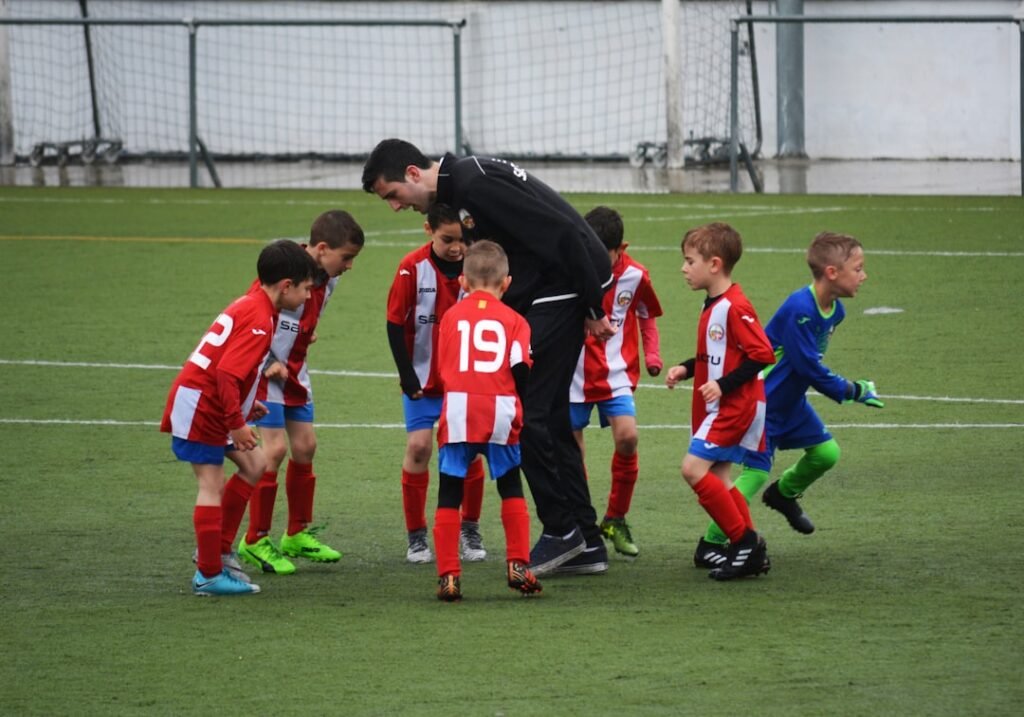
You spend three sessions teaching a 4-3-3. You draw it, you walk it, you name every position. Then Saturday arrives, the first goal kick goes long, and what you are watching does not look like a 4-3-3 at all. The wingers have drifted inside, the midfield three has flattened into a line, and there are four players inside the width of the penalty area chasing the same ball.
Most coaches read that as a discipline problem. It usually isn’t. The players learned exactly what they were taught — a static arrangement of eleven dots — and a match rarely stays still long enough for a static arrangement to help. This is one of the more common problems a soccer tactics board is used to solve, but only if what you put on it is shape in motion rather than a formation frozen at kickoff.
A Formation Is a Starting Point, Not a System
A formation describes where players stand before the ball moves. That is genuinely useful: it tells a player who their nearest teammates are, roughly how much of the pitch they are responsible for, and where to return to when the picture gets messy. What it does not describe is what the team should look like eight seconds later, once the ball has travelled into midfield and three opponents have shifted.
A lot of formation teaching stops right there, and that is usually why shape falls apart. Players get handed one arrangement and are asked to hold it through situations that call for several different ones. The more useful framing — and the one that tends to stick with players — is that a formation is the reference point a shape returns to, not the shape itself.
The Same Formation Has More Than One Shape
Take an 11v11 side set up in a 4-3-3. With the ball in the opposition half, that team might look far closer to a 3-2-5: one full back steps into midfield, the wingers hold width high, the centre forward occupies the last defender. Without the ball, defending in their own half, those same eleven players might sit in something nearer a 4-5-1, both wingers dropping into the midfield line.
Same players. Same formation on the team sheet. Two very different shapes, and several more in between.
Defending is a clean way to teach this, because the priorities follow an order. A defending team is trying to prevent chances to score, and it works through that in sequence: close the middle in front of the front line first, then close the middle in front of the midfield line, then close the middle in front of the back line, and finally close the middle behind the back line. A player’s responsibility in a given moment — their role — is right when it serves whichever of those the team is actually doing at that moment. The formation cannot tell them which one is happening. The shape can.
Why a Soccer Coach Board Shows This Better Than a Static Diagram
A printed formation diagram can only ever show one moment. That is its ceiling. The instant you want to show a second moment, you need a second diagram, and the connection between them — the part that actually matters — exists only inside your explanation.
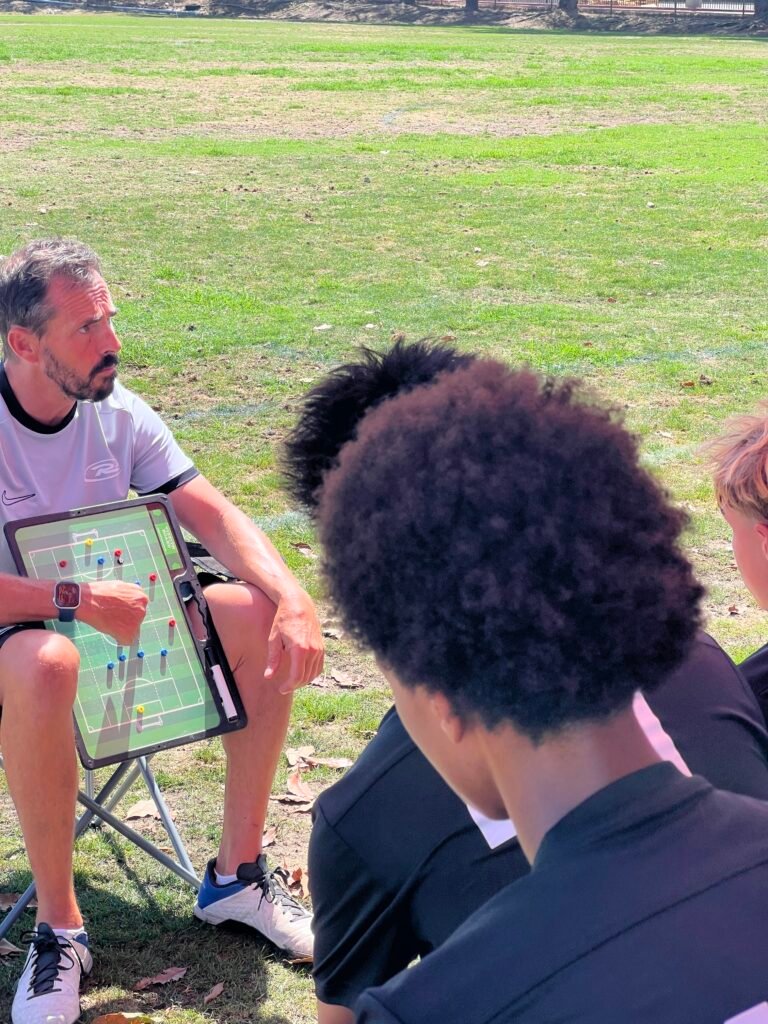
Magnets solve that, because the same eleven pieces can be moved through several moments while the group watches it happen. That is the practical argument for a soccer tactics board with magnets over a laminated sheet: a player watches the full back start wide, step inside, and finish central, instead of being shown two unrelated pictures and asked to imagine the movement between them.
Two things make that work. The magnets need to hold position while you talk, and they need to be small enough that the space around them stays visible — a magnet that covers the zone it is standing in defeats the point of drawing the zone at all. The pitch also has to be drawn to soccer tactics board proportional scale, because the distances are the lesson. If the gap between the midfield line and the back line is drawn generously, the compactness you are asking for on the board is not the compactness you will get on Saturday.
The Vizzionboard front side is a full 11v11 pitch at true proportional scale, with 23 numbered positional magnets covering both teams — enough to show your shape and the opposition shape at the same time, which is usually what an honest formation conversation needs. Both sides are magnetic and dry-erase, so you can place the magnets and draw the movement between positions within the same explanation. You can see the full setup in the shop.
A Practical Pattern: The Three-Snapshot Walkthrough
Here is a training pattern that tends to land better than explaining a formation once and hoping it survives contact with a match.
Before the session, set your eleven magnets in the starting formation. Then walk the group through three snapshots of that same team, moving the magnets rather than redrawing from scratch each time: first, the opposition goalkeeper has the ball; second, the ball is contested in central midfield; third, your team is in possession in the final third. At each snapshot, ask two questions rather than delivering two instructions — who is nearest the ball, and what space are we protecting or attacking right now.
Then take it to the field. Run the three shapes unopposed first, so players can move through them without pressure, and only then add opposition. Finish back at the board and ask one player to set the magnets to the shape the team actually held during the second snapshot. The distance between what you drew and what they set is usually your next session’s topic, and it tends to be a more honest measure of what transferred than anything you could ask them verbally.
Scaling the Idea Down to 7v7 and 9v9
Everything above is 11v11 language. A 9v9 or 7v7 group is working on the same underlying idea — the shape changes depending on where the ball is — but the vocabulary has to change with it. Explaining to a 7v7 group that a defender steps into midfield to build a 3-2-5 is not going to land, and phrases like holding width in the half-space belong with older players who have the reference points to make sense of them.
For smaller formats, the same lesson usually works better as three plain questions asked at each snapshot: where is the ball, how far are you from it, and are you nearer your own goal or theirs than the ball is. That is the identical concept scaled to what the group can actually hold onto. Format does not change the principle; it changes the vocabulary and how many pieces you put on the board at one time. Fewer magnets and simpler questions tend to produce more understanding at those ages than a complete tactical picture nobody can carry onto the pitch.
What This Looks Like Across a Whole Club
For a club running several age groups, this compounds when every coach teaches shape the same way. If the under-11 coach is asking those three plain questions and the under-16 coach is walking through the same three snapshots with more detail, a player moving up an age group meets a familiar method rather than starting over with someone else’s vocabulary. That consistency is difficult to hold together when each coach relies on their own explanation style, and considerably easier when they are all working from the same visual reference. Clubs outfitting a full coaching staff with Vizzionboard can find bulk options on the club pricing page, which is usually where a technical director’s conversation starts.
None of this requires complicated equipment. It requires something accurate, durable enough for a bag that gets opened two or three times a week, and simple enough that a coach reaches for it before a session rather than leaving it in the car. That is the standard behind these player development tools soccer coaches keep in rotation, and it is why the slogan is Built to Develop Champions — not because a board wins matches on its own, but because a player who can see how the shape moves tends to arrive in the right place sooner.
Show the System, Not Just the Formation
If your team is still being taught one arrangement of eleven dots and asked to hold it for ninety minutes, the fix is not more repetitions of the same diagram. It is showing them the same team in three different moments and letting them watch the shape travel between them. Take a look at the Vizzionboard tactics board and start teaching shape in motion this week. Built to Develop Champions.