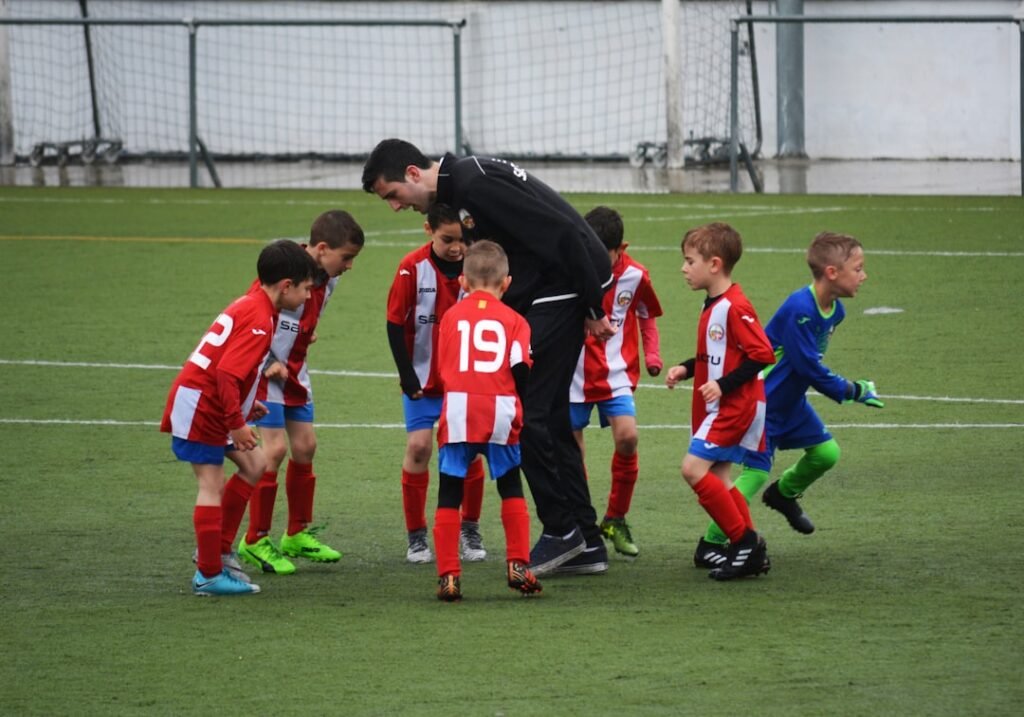
It’s Thursday night, and the team talk is dialed in. You’ve got the shape out of the back mapped, the pressing trigger you want the moment the ball goes into their deep-central third, the exact half-space you want your right winger arriving into on the switch. By Saturday morning, half of it is gone. Not because the players weren’t listening — because words alone, even good ones, rarely survive contact with an actual match.
This is the problem every coach at every level eventually runs into: the gap between what you explain and what a player can actually picture well enough to execute under pressure. Closing that gap isn’t about talking longer or louder. It’s about giving players something spatial to look at — and that’s where the right soccer tactics board stops being a nice-to-have and starts being one of the more useful youth soccer coaching tools in a coach’s kit.
Why Verbal Instruction Alone Doesn’t Transfer to the Pitch
Most team talks are verbal because that’s the fastest way to deliver information in a fifteen-minute window before training or a match. The trouble is that football is a spatial game, and spatial ideas don’t hold up well when they’re only spoken out loud. A coach can say “hold the width in the half-space” a dozen times to an 11v11 team, but if a player has never seen exactly where that half-space sits relative to the rest of the pitch, the instruction is abstract. Younger players in a 7v7 or 9v9 format need that same picture built from simpler language, but the underlying problem doesn’t change: it doesn’t survive the first fifteen minutes of a real match, once decisions have to be made in half a second instead of a team meeting.
Cones on a table or a hand-drawn sketch on a notepad help a little, but they usually approximate the picture rather than represent it accurately. If the zones aren’t drawn to real proportions, players are learning a slightly wrong picture of the game — which is often worse than learning no picture at all, because it has to be unlearned later.
What a Best Soccer Tactics Board for Coaches Actually Needs to Do
Ask coaches what they want from a soccer coach board and the wish list is usually the same: something that shows real spacing, holds up to weekly use, and works for a full squad walkthrough as easily as a one-on-one conversation with a player after training. A few things separate a board that gets used every week from one that ends up in a bag closet by October:
- True proportional scale. Horizontal thirds, half-spaces, central corridors, and wide zones need to match the real pitch, not an artist’s impression of it. A soccer tactics board proportional scale is what lets a coach point to a spot and say “this exact area” instead of “roughly here.”
- Magnets and a dry-erase surface working together, not as two separate modes. Real coaching moments mix positioning with movement — a coach needs to place a magnet for where a player starts, then draw the run, the pass, and the space they’re attacking, all in the same explanation.
- Enough pieces to show a full picture. A tactics board that only ships with a handful of magnets forces a coach to explain half the picture and imagine the rest, which defeats the purpose.
- Portability. If it can’t travel from the sideline to the locker room to a parent conversation, it won’t get used consistently.
Dual-Sided Means Full-Session Flexibility, Not Two Separate Modes
One detail that separates a genuinely useful soccer tactics board with magnets from a basic whiteboard is having two distinct working surfaces in one piece of equipment. A full 11v11 pitch on one side lets a coach walk through team shape, defensive structure, and horizontal thirds at full scale. A half-pitch on the other side is built for zooming into exactly what happens in the attacking or defensive third — pressing triggers, overloads in the half-space, a specific corner routine — without the rest of the pitch crowding the picture.
The two sides aren’t interchangeable, and that’s the point: they’re different tools for different moments in the same session. And because both surfaces are magnetic and dry-erase together, a coach can place the 23 numbered positional magnets — covering both teams across a full 11v11 — and draw directly over them with the included marker, on whichever side is up, without switching equipment mid-explanation. Pack it back into its carry bag afterward, and the same board goes from training ground to team meeting to a parent’s kitchen table.
A Training Exercise You Can Run With It This Week
Here’s a simple way to put a tactics board to work instead of just pointing at it once and putting it away. Before your next session, use the board to walk your team through a single pressing trigger — for example, “when the ball goes into their deep central third, our nearest player presses immediately and the two closest teammates cut the passing lanes inward.” Place the magnets to show exactly who moves and where the space closes. Keep it to one trigger, not five.
Then take that trigger straight into a small-sided pattern on the field — format doesn’t matter, 7v7, 9v9, or 11v11 all work — and rehearse it until it’s automatic rather than remembered. Afterward, bring the board back out and reset the magnets to show what actually happened in training versus what you drew beforehand. That before-and-after comparison is often where the concept truly clicks, because players can see the gap between the plan and the execution instead of just hearing about it.
Why Coaches at Every Level Choose a Board Built to Real Scale
Vizzionboard was built around one core idea: a tactics board only teaches accurately if its zones actually match the real pitch. It’s built to true proportional scale and carries a US Design Patent for that design — which is why it’s found its way into sessions run by collegiate, high-school, and club coaches who need the picture they’re drawing to hold up under real tactical scrutiny, not just look good on a whiteboard.
Every board ships with the 23 numbered positional magnets for both teams, a dry-erase marker and eraser, and a protective carry bag, at $59.99 — with club pricing starting at $47.99 for orders of 10 or more, built for technical directors who want the same visual language taught consistently across every age group in their club. That consistency matters more than it sounds: when every coach in a club is drawing half-spaces and horizontal thirds to the same real proportions, players moving up through age groups don’t have to relearn the picture every season. They just add to it.
Turn the Team Talk Into Something Players Actually Retain
The gap between what a coach explains and what a player can execute rarely closes with more words. It closes with a picture the player can actually see — one built to the same proportions as the pitch they’re about to step onto. That’s the real job of a soccer club coaching equipment investment like a proper tactics board: not to look impressive on the sideline, but to make Thursday night’s team talk survive all the way to Saturday’s kickoff.
See the Vizzionboard tactics board and put it in front of your team before your next session. Managing multiple teams across a club? Vizzionboard’s club pricing makes it easy to give every coach in your program the same board, and the same shared language, to teach from.