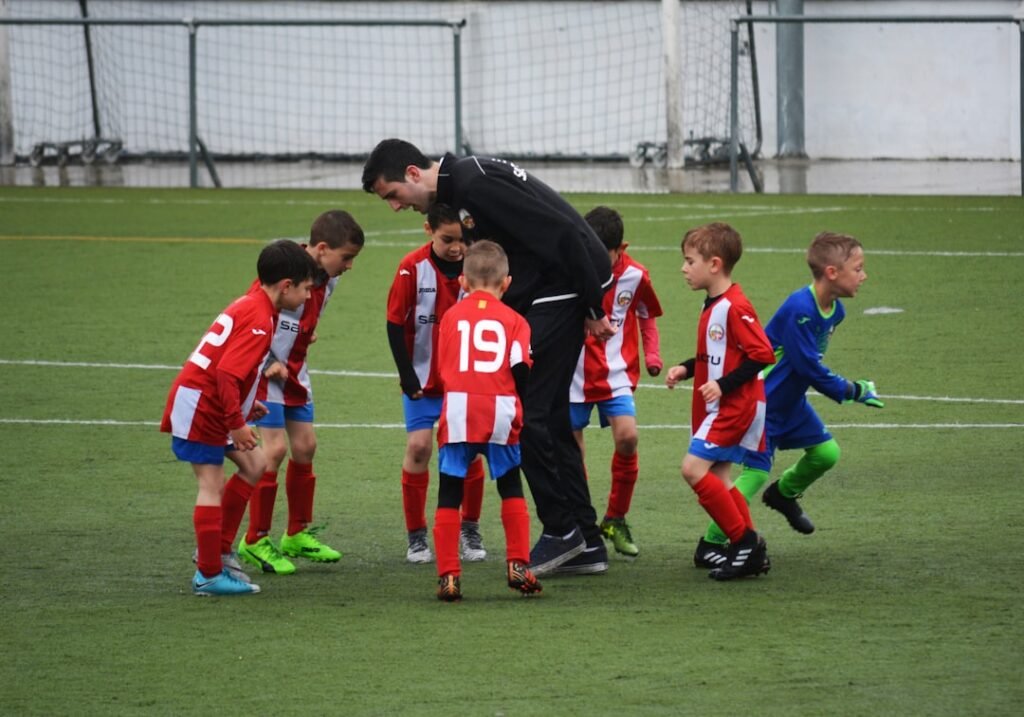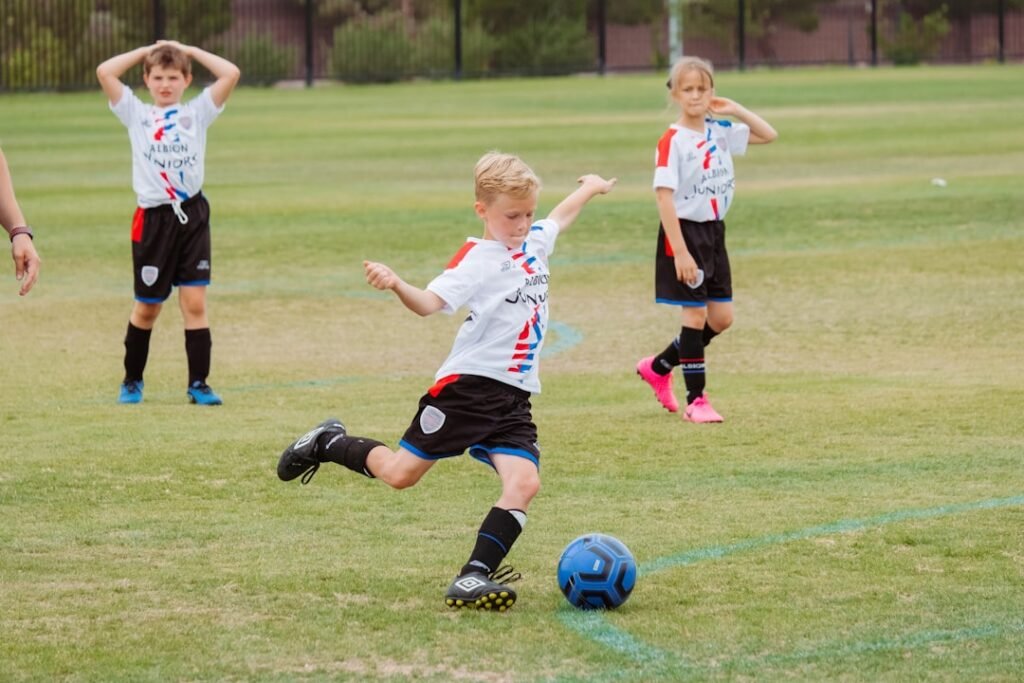
Watch the first five minutes of almost any youth match — 7v7, 9v9, 11v11, it doesn’t matter — and you’ll see the same picture. Half the team ends up crowded around the ball, in the same ten yards of grass. The coach shouts “spread out,” and nothing changes, because “spread out” isn’t an instruction a young player can actually act on. It describes the problem. It doesn’t fix it.
The real issue isn’t effort, and it isn’t a lack of energy on the sideline. It’s that getting open is actually two separate skills, and most youth coaching only ever addresses one of them.
Getting Open Is Two Skills, Not One
The first skill is spatial: creating space, moving into a better position than the crowded one a player started in. This is what most coaches mean when they yell “spread out” — and it’s real, but it’s incomplete on its own.
The second skill is body orientation — how a player’s hips and shoulders are angled the moment the ball actually arrives. A player can create textbook space and still receive the ball with their back to the game, unable to see a single option around them. That player isn’t open. They’re just standing somewhere quieter.
Body Orientation Is the Real Unlock
This is where most positional coaching stops short. Coaches talk about space constantly, but rarely coach the body shape that makes space useful. An open body orientation — hips and shoulders angled so a player can see the whole pitch — is what actually lets them read the game: when to release the ball, which direction to progress it, and how quickly they need to act once they’ve decided.
A player who receives the ball closed — back to their own goal, unable to see the field — can’t read any of that. They’re guessing. Every rushed pass, every heavy touch that gets immediately swarmed, every “why didn’t they just turn” moment in a youth match usually traces back to this one thing: the player never had their body oriented to see the game in the first place.
This is also why decision-making and physical technique tend to break down at the exact same moment. A closed body can’t decide well, and it can’t execute well either — two problems that look separate from the sideline are often the same root cause, showing up twice.
A Training Exercise That Teaches It
Here’s a simple training exercise that isolates body orientation without turning the whole session into a lecture: run a 4v2 or 5v2 possession pattern in a tight grid, with one rule — every player must check their shoulder and receive on the half-turn before their first touch. No half-turn, the possession resets. It sounds small. In practice, it’s one of the fastest ways to make an invisible habit visible, because players feel the difference between receiving open and receiving closed almost immediately.
The following week, run the same pattern in a slightly larger grid and ask players to also call out, out loud, which direction they’d progress the ball before they receive it. That one addition connects body orientation directly to decision-making — the two skills stop being separate lessons and start becoming a single habit.
Why Visual Tools Change How Fast This Sticks
Positioning concepts like this are hard to teach with words alone, because “open” and “closed” are spatial ideas — far easier to show than to explain. This is where a soccer tactics board earns its place in a coach’s kit. Vizzionboard is built to true proportional scale, so the zones, half-spaces, and horizontal thirds a coach draws on it actually match the real pitch, rather than approximating it. When a coach can place a magnet, angle it, and show a player exactly what an open versus closed body shape looks like relative to real space on the field, the concept stops being abstract and starts being something a ten-year-old can see.
That’s the difference between a whiteboard prop and genuine youth soccer coaching tools: one illustrates a formation, the other actually teaches spatial reasoning players can carry onto the pitch. Coaches who build Vizzionboard into regular session planning consistently point to body-shape and positioning work as the concept that clicks fastest once it’s visualized on a board built to scale, instead of sketched on a notepad between drills.
For technical directors managing this across several age groups, a dual sided soccer tactics board — a full pitch on one side, a half-pitch on the other — means the same positioning language can be taught from 7v7 all the way through 11v11, without switching equipment or re-explaining the zones from scratch every season.
Why This Matters Beyond One Match
Positioning is one of the few player development tools soccer coaches can actually measure improvement in week to week — not by counting goals, but by watching how often a player receives open instead of closed. It’s a habit that compounds: a player who can consistently orient their body to read the game becomes easier to coach on everything else, because they can already see what a coach is asking them to react to. That’s a meaningful head start heading into any club’s higher-level teams, and exactly the kind of visible, repeatable progress parents notice.
A proper soccer coach board — one that treats zones and half-spaces as real, proportional space rather than a rough sketch — turns that habit from something a coach has to describe over and over into something a player can see for themselves.
Make Positioning a System, Not a Sideline Shout
“Spread out” will keep failing as an instruction, because it was never really an instruction — it was a wish. What actually works is treating positioning as two coachable skills: creating space, then orienting the body to use it. Once a player can do both, the rest of the game — timing, direction, tempo — starts to look less like guessing and more like reading.
See the Vizzionboard tactics board and start building that habit into your very next session. Coaching a full club across several age groups? Vizzionboard’s club pricing makes it easy to put the same board, and the same shared language, in front of every team you coach.