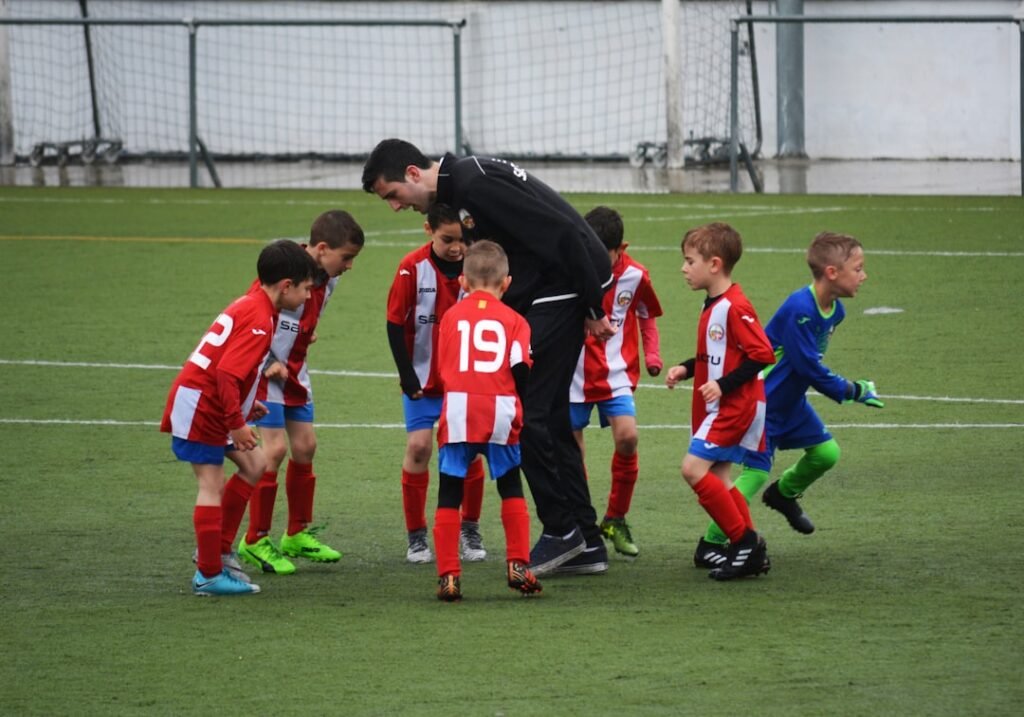
“Why do my players all end up in the same ten yards?”
Every club coach has watched it happen. The ball shifts to the right wing, and suddenly six players are standing shoulder to shoulder in a space the size of a parking spot. Nobody occupies the far side. Nobody drops into the pocket between the lines. The pitch — a 70-by-45-yard rectangle bursting with usable space — gets reduced to a scrum around the ball, and every training session this week feels like you’re re-teaching the same lesson from scratch.
The problem usually isn’t effort. It’s that most players have never been taught to see the pitch as a set of zones. They see the ball. They see the nearest opponent. They don’t see the horizontal thirds, the half-spaces, or the wide corridors that professional teams use to stretch defenses and create passing lanes. That’s a coaching gap, not a talent gap — and it’s one of the most fixable problems in youth and club football once you have the right visual language to teach it.
Horizontal Thirds Soccer Coaching: The Foundation of Zone Occupation
Before a player can understand where to run, they need to understand where they are. Dividing the pitch into horizontal thirds — defensive, middle, and attacking — is the simplest entry point into positional play, and it’s the first concept I put in front of any group, regardless of age.
The idea is straightforward: each third carries a different responsibility. In the defensive third, the priority is compactness and delaying the opponent. In the middle third, the team needs patience and control — this is where games are actually won or lost, because it’s where possession changes hands most often. In the attacking third, the priority flips to penetration and risk.
Here’s where most coaches lose players: they explain this concept verbally, on a whiteboard with a rough rectangle, and expect it to translate onto a real pitch that’s ten times larger. It doesn’t. Players need to see the thirds drawn to actual proportion — not “somewhere around midfield” but the exact zone lines they’ll be standing in twenty minutes later. This is precisely why proportional scale matters more than most coaches realize when picking soccer coaching aids. A tactics board that isn’t drawn to true pitch proportions teaches a distorted picture of the game, and players carry that distortion onto the field.
Half-Space Coaching: Where Games Are Actually Won
Once players grasp horizontal thirds, the next lesson is the one that separates organized teams from chaotic ones: half-spaces. The half-space is the vertical corridor between the wide channel (the space near the touchline) and the central corridor (the space between the two centre-backs or centre-mids). It’s not out wide, and it’s not through the middle — it’s the lane that most youth players never learn to occupy because nobody ever draws it for them.
Why does it matter so much? Because the half-space is where a player gets the best of both worlds: enough central proximity to combine with a striker or turn toward goal, and enough width to avoid being swallowed by a double-team. Elite full-backs, inverted wingers, and attacking midfielders live in this corridor for a reason — it’s the hardest zone for a defense to mark without giving up something else.
Teaching half-space occupation verbally is nearly impossible. Players need to see the four vertical lanes — left wide, left half-space, right half-space, right wide — mapped out against the real width of the pitch, ideally with magnets they can physically move to show how a winger tucking into the half-space drags a full-back out of position and opens the channel behind. This is a case where a half-space coaching board earns its keep in a session: it turns an abstract tactical principle into something a 14-year-old can point at and repeat back to you.
Central Corridors and Wide Zones: Teaching Width Without Losing Compactness
The third piece of the zone-coaching puzzle is helping players understand the relationship between the central corridor and the two wide zones. Young teams tend toward one of two extremes: either everyone crowds centrally and the team has no width, or the wide players hug the touchline so tightly that the central corridor turns into a traffic jam with no outlet.
The fix is teaching occupation as a system, not a set of individual instincts. A simple rule I give teams: only one line of players occupies the central corridor at a time — if the striker drops into it, the attacking midfielder holds width or shifts into a half-space instead. This is a direct application of Space = Time: the more disciplined a team is about not duplicating zones, the more time on the ball every player receives, because defenders can’t double up on a zone that’s already spaced out.
This is also where a dual sided soccer tactics board becomes genuinely useful in-session rather than just for pre-match prep. Full-pitch zone structure on one side, a condensed half-pitch view on the other for isolating a specific third — a coach running through central-corridor discipline with a back four doesn’t need the full 11v11 picture cluttering the moment.
A Practical Training Exercise: The Four-Corridor Occupation Pattern
Here’s a training exercise I use to make this concept stick physically, not just visually:
- Setup: Mark the pitch (or a training grid) into four vertical corridors — left wide, left half-space, right half-space, right wide — plus the central corridor, five lanes total across the width.
- Rule: No two attacking players may occupy the same corridor at the same time. If a player enters a teammate’s corridor, that teammate must immediately shift to an open one.
- Progression: Start as an unopposed possession pattern (8v0) so players internalize the spacing, then add two floating defenders whose only job is to press the ball — forcing attackers to solve the “who moves where” problem under pressure.
- Coaching point: Freeze the pattern when two players collide in a corridor and ask the group which zone was left empty. Making players identify the gap themselves builds the habit faster than pointing it out for them.
Run this for ten minutes before a normal possession session and you’ll notice the spacing carry over almost immediately — players start scanning for empty corridors instead of just chasing the ball.
Turning Zone Theory Into a Repeatable Coaching Habit
None of this sticks after a single walkthrough. Zone occupation is a language, and like any language, it needs repetition in the same visual format every week until it becomes instinct. That consistency is exactly what a good soccer coach board is for — not a one-time prop for matchday team talks, but a tool you pull out at the start of every session to reinforce the same thirds, the same half-spaces, the same corridors, until players stop needing you to explain it at all.
This is the thinking behind how we built the Vizzionboard tactics board. It’s drawn to true proportional scale — horizontal thirds, half-spaces, wide zones, and central corridors all measured to match a real pitch, not estimated by eye — because a zone that’s drawn wrong teaches players the wrong picture of the game. Both sides are full magnetic and dry-erase, so you can set 23 numbered positional magnets for a full 11v11 shape on the full-pitch side, then flip to the half-pitch side to isolate a defensive third or a wide combination pattern and draw directly over it with the included marker. It’s one of the most practical soccer club coaching equipment additions for clubs trying to build a shared tactical vocabulary across every age group and every coach on staff — everyone teaching zones the same way, off the same board.
If you’re searching for the best soccer tactics board for coaches who are serious about teaching positional play rather than just drawing arrows before kickoff, proportional accuracy is the detail that actually matters. See the full Vizzionboard board and included magnets in the shop, and if you’re outfitting a whole coaching staff, check club pricing for 10 or more boards to get every team teaching zones the same way.
Your players already run hard. Give them a way to see the space they’re running into. Get your Vizzionboard tactics board today and start turning zone theory into a habit your team carries onto the pitch — built to develop champions, one corridor at a time.