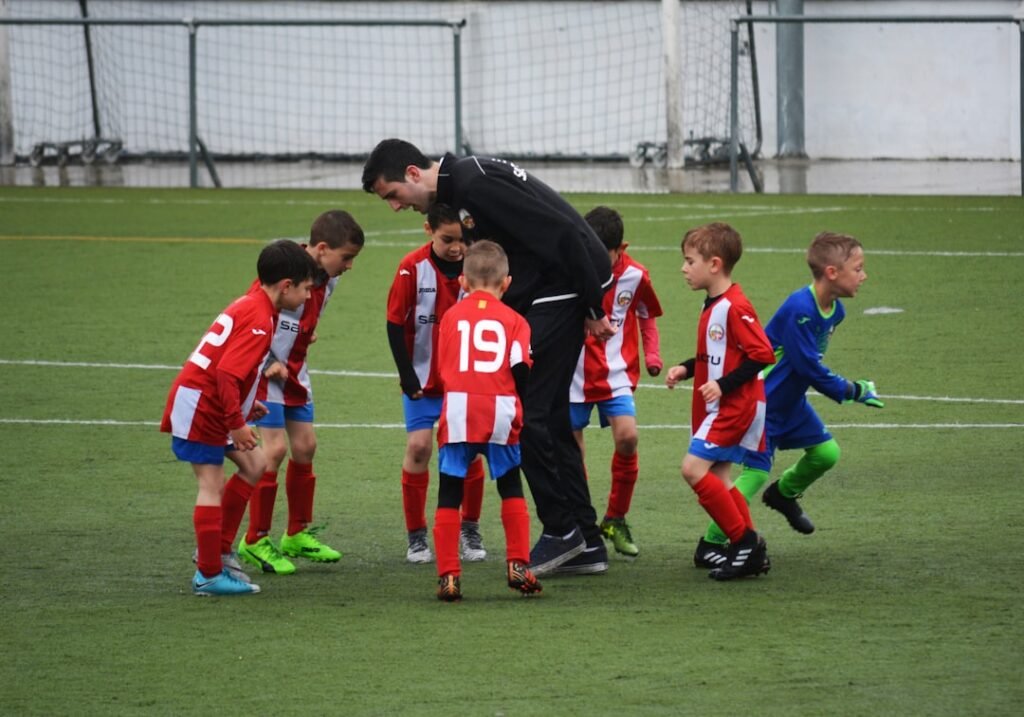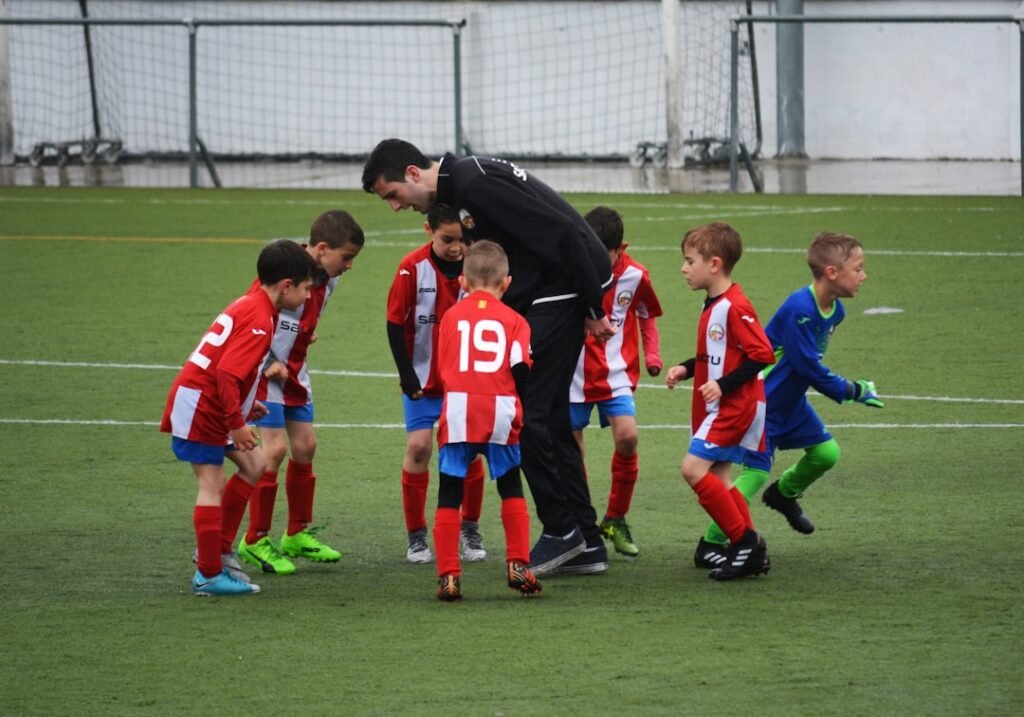
Your midfielder receives the ball, head down, and the game stops. Not because the whistle blew — because she stopped. Two seconds of hesitation. A shoulder check that came a half-second too late. A pass played backward when space was screaming open ahead. You’ve coached the run, you’ve coached the shape. But the decision still isn’t there.
This is the most common frustration in youth football coaching, and it has nothing to do with effort or athleticism. It’s a spatial awareness problem — and it’s one that no amount of shouting from the touchline can solve. Players don’t freeze because they’re lazy. They freeze because they haven’t built the mental picture of the pitch that allows them to act before the pressure arrives.
The good news: spatial awareness is trainable. The better news: it’s trainable off the pitch, with the right player development tools for soccer coaching sessions. Here’s how.
Why Spatial Awareness Is the Real Engine of Player Development
Elite coaches talk about “playing with your head up,” but that phrase undersells the cognitive work involved. What we’re actually describing is the ability to build and constantly update a mental map of the pitch — who is where, which zones are occupied, which corridors are open, and what will happen in the next two seconds if you receive the ball right now.
Players who struggle with this aren’t just slow to decide. They’re operating without a reliable internal pitch model. They’ve never been given a framework to organize the information flooding at them during a live game. The solution isn’t more game time — it’s deliberate pattern-loading: showing players what the pitch looks like at key moments, and teaching them to read those patterns before the ball arrives.
This is exactly where a quality soccer tactics board changes the development conversation. When a coach can show a player — using magnetic pieces on a proportionally accurate pitch diagram — what the field looks like from the defensive midfielder’s angle in a 4-3-3 build-up, the player gains a reference image they can actually recall under match pressure. That’s not a tactical lecture. That’s deliberate cognitive loading.
The Pitch Zones Your Players Don’t See (But Should)
One of the most powerful reframes in modern football coaching is teaching players to think in zones rather than positions. A player who knows she is “the number 8” often anchors to a physical location on the pitch. A player who understands zone occupation — who grasps that the half-spaces between the opponent’s wide defender and central midfielder are nearly always available in a settled defensive shape — can exploit space that positional players walk past entirely.
The key zones worth loading into your players’ mental maps:
- Horizontal thirds: Defensive, middle, and attacking thirds each carry different risk profiles and passing priorities. Knowing which third you’re in should immediately constrain your decision tree — a risky square pass in the defensive third that would be fine in the middle third is a coaching problem waiting to happen.
- Half-spaces: The channels between the center backs and fullbacks (defensively) or between the opposition’s wide and central midfielders (offensively). These are some of the most underused spaces in youth football because players haven’t been shown how to find and time their runs into them.
- Wide spaces and central corridors: Width creates the compression that opens the middle. Teaching players why they should be wide when the team is in possession — not because the coach says so, but because they understand the spatial logic — unlocks a completely different quality of possession play.
The challenge? Drawing these concepts on a whiteboard with hand-sketched ovals produces a distorted picture. When the zones aren’t to real-pitch proportions, players internalize the wrong geometry. They run to the wrong depth, they time movements incorrectly, they misjudge distances. This is why a football tactics board built to true proportional scale is not a luxury — it’s the difference between a concept that transfers to the pitch and one that stays in the training room.
From the Board to the Brain: A Practical Training Pattern for Spatial Decision-Making
Here’s a pattern I’ve used with club teams across multiple age groups to accelerate spatial awareness development. It starts at the tactics board and moves onto the pitch in stages.
The “Freeze Frame” Pattern
Before training begins (10 minutes at the board): Set up a game scenario on your soccer coach board — say, your team building from the back in a 4-3-3 against a mid-block 4-4-2. Place the positional magnets in a realistic position — ball at the right center back, defensive shape compressed centrally. Ask your midfielder: “Where is the space right now? What happens in three seconds if we play here versus here?”
Don’t give the answer. Let them point at the board. Let them trace the movement with a finger. When they’re wrong, move the magnets to show the consequence. When they’re right, ask why it’s right. This ten-minute session loads the cognitive framework that the live rondo or 7v7 will reinforce.
On the pitch (rondo into transition, 20-25 minutes): Run a 7v3 possession pattern in a marked grid that mirrors the board’s proportional zones. Every time possession breaks down, the coach calls “freeze” — all players hold still. Walk in, point to the nearest player: “What just opened up before the turnover? Where should you have been positioned?” Then let play restart from that moment.
The connection between what they saw on the soccer tactics board with magnets and what they experienced in the live freeze is where the spatial memory cements. Players begin to develop the capacity to “pre-see” — to read patterns before they fully develop.
Coaching note: Use the dual-sided board to your advantage here. The Vizzionboard’s full 11v11 side lets you map the whole team shape, while the half-pitch side gives you the zoomed-in tactical picture — the half-space movement, the fullback overlap, the striker’s pressing trigger — in proportional detail. You’re not guessing at distances. Every zone and every run length mirrors what the players will experience on the real pitch.
Why Decision Speed Is a Coaching Problem, Not a Talent Problem
Here’s the uncomfortable truth most coaches eventually arrive at: when a player consistently makes slow or poor decisions, it rarely means the player lacks football intelligence. It means the player hasn’t been given enough structured exposure to the game’s patterns at a cognitive level.
Elite academies have understood this for years. They use video analysis, positional pattern-loading, and tactical walkthroughs before and after training sessions specifically because research in sports cognition shows that mental rehearsal — seeing a scenario before executing it — accelerates the automation of decisions. A player who has mentally rehearsed the half-space run fifty times before the season begins will execute it in-game without conscious thought.
Most youth coaches don’t have video systems. What they have is fifteen minutes before training, a whiteboard, and maybe a magnetic board from a sporting goods store. The difference between a coaching session that changes players and one that doesn’t often comes down to whether the tools match the intent. A youth soccer player development board that shows accurate zones and lets a coach manipulate a full 11v11 scenario with numbered magnets is a serious coaching aid — not a novelty. It’s the difference between talking about the half-space and actually showing it.
Club directors looking to build consistent methodology across their coaching staff will find that the club pricing options for Vizzionboard make it possible to equip every coach with the same proportional pitch system, so the language and the spatial frameworks are identical whether a player is in U10 or U17. That kind of curriculum consistency is what moves clubs from good to excellent.
Building the Habit of Seeing First
The end goal of spatial awareness training isn’t players who know where to stand. It’s players who read the game before they receive the ball — who have made their decision before the pass arrives, whose shoulder checks are automatic, whose movement into space is anticipatory rather than reactive. That’s the threshold between a player who plays the game and a player who influences it.
The path there is structured, visual, and repetitive. It starts at the board, moves into pattern exercises, and eventually becomes instinct. A good soccer coaching aid — one that shows the real pitch geometry, that lets you manipulate full-team scenarios, that a player can stand in front of and physically trace movements — is one of the highest-leverage tools in a youth football coach’s kit.
Because at the end of the day, the game is decided by the players. The coach’s job is to build the mental models that let the players make the right calls. Give them the right picture, and they’ll find the space themselves.
Ready to upgrade your player development sessions? Explore the Vizzionboard — built to true proportional scale, dual-sided (full pitch + half-pitch), magnetic and dry-erase on both sides, with 23 numbered positional magnets for complete 11v11 scenarios. Shop Vizzionboard at vizzionboard.com/shop and start building the mental models your players need. Built to Develop Champions.