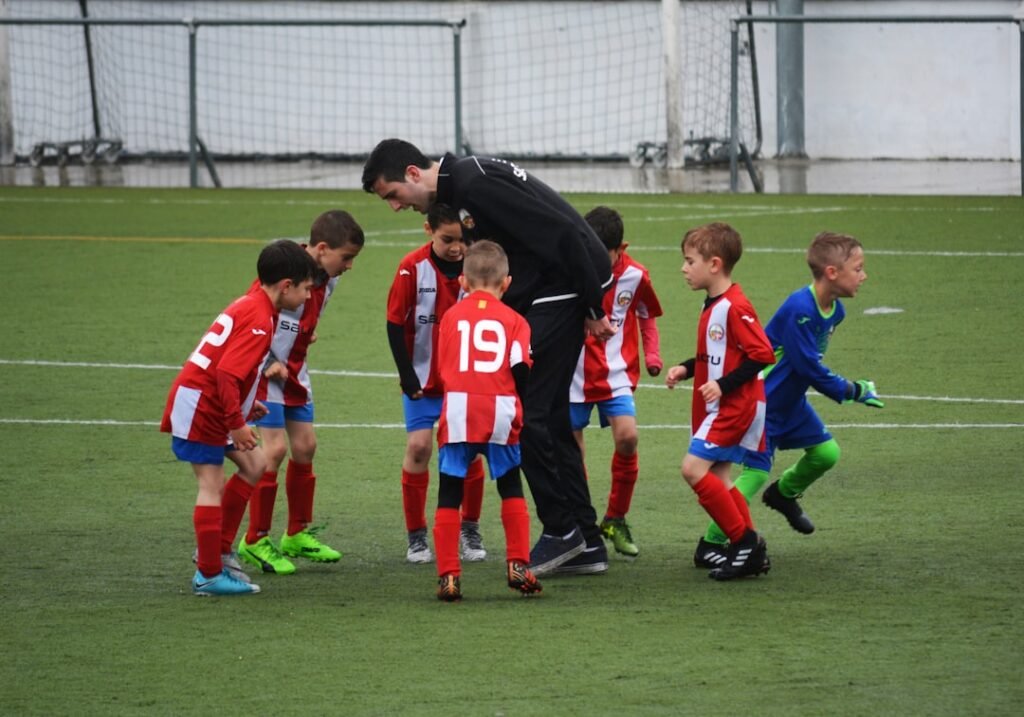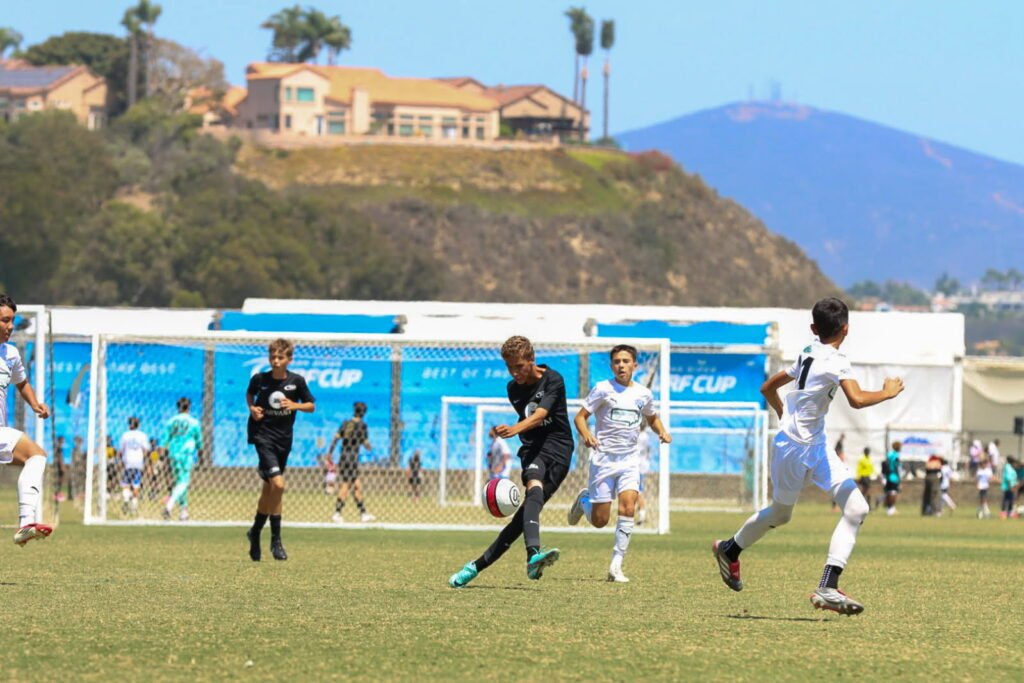
It is Saturday morning, 9v9, and your central midfielder plays the ball wide to your right winger near the touchline. Inside of three seconds, six of your players have drifted toward that side of the field. Your left back has tucked infield. Your center forward has dropped into the same space your other central midfielder is already standing in. Out on the far side, twenty-five yards of grass sits completely unoccupied.
You have probably said some version of “spread out” yourself. The players spread out for one possession, the ball travels, and they collapse again. The instruction is not wrong, it just tends not to hold, because it treats what you can see rather than what caused it. A soccer tactics board is built to provide a visual learning environment, and that is exactly what this problem needs: your players are not collapsing on the ball because they forgot to spread out. They are collapsing because the ball is the only thing they are watching.
Why Players Crowd the Ball: They Are Reacting, Not Reading
When a player moves because the ball moved, they are reacting. There is a useful question to ask before correcting any player who ends up in the wrong place: is it a communication/game tactical principle problem, or is it a game insight problem? Did they fail to see what was in front of them, or did they see it clearly and choose something else?
With ball-watching, it is almost always the first. A player who is only reacting to the ball never read the situation at all, so there was nothing to base a decision on. They did not weigh the space available and decide against moving into it. They never saw that space to begin with.
Communication, which is also called reading the game, starts with position: as open as possible, as closed as necessary. That is body orientation — but a player also has to move into a better position, and that movement has to come at the right moment, in a specific direction, and at the right speed. A player standing with their body turned toward the ball, closed off from the rest of the field, cannot see the space available, so they cannot judge when to move into it, which direction to take, or how fast to go. That player is guessing, and guessing tends to look like following the ball.
This is why “spread out” rarely changes much on its own. It is words alone, and young players tend not to hold onto a picture from words alone.
Horizontal Thirds Let Players See What You Mean
The simplest thing you can hand a player instead is a reference point that does not move every time the ball does. Which third of the field is the ball in right now, the defensive third, the middle third, or the attacking third? It sounds almost too basic to spend a session on, but it can help to give young players a spatial reference and can connect their role to the team tactics in a specific area of the field.
In other words, the thirds change what is being asked of the same player. For example, your center back receiving in the defensive third might be pressed, and the team tactics might be to circulate the ball quickly to find the open player. If that same center back steps into the middle third with the ball, opponents might close in from more than one direction, with less space to turn, and the team tactics might be to play forward to a teammate who is open. And if that center back stays forward after a corner and receives in the attacking third, they are usually working against a defense that is already organized, where half a second of hesitation can be the difference between a shot and a turnover.
This is where a soccer tactics board with magnets does something a sideline instruction cannot. You can position the magnets exactly where your players actually were on Saturday, leave them sitting there while you talk, and point at the third the ball was in. On the Vizzionboard those thirds are drawn to exact proportional measurements rather than approximated, so when a player looks at where the middle third ends, that line means on the board what it means on a real field. Magnets that hold their position while you explain, and that are small enough to leave the space around them visible, are what make that conversation possible at all.
Which Spaces Are Available, and Who Is Positioned to Exploit Them
Once the thirds are familiar, the next layer is which spaces are available and who is in a position to use them. When your team is attacking, the task is to create chances to score, and the spaces come in a priority order: the space behind the opposition back line first, then the space behind their midfield line, then the space behind their front line, then the space in front of it.
Work a real situation through that order. The opposition center back steps up to press your central midfielder. That step forward vacates the space behind the opposition back line. Your players positioned on the attacking front line are the ones in a position to exploit it. Which of them actually goes, though, is decided by how you have set your team up to attack, not by the position printed beside their name. Your team tactics might send one of them into the space behind the back line while another comes short to exploit the space behind the midfield line, which means the next space in the team’s order of priority is occupied too. Each player needs to know which role your team tactics give them.
In 11v11, the field is also wide enough to divide into a central corridor with a half-space on either side of it, and older players can usually work with those names directly. The half-spaces are already drawn on the board, so players can see those spaces while you talk instead of relying on what they remember from last week.
The same reading applies when the ball is not moving at all. Corner kicks and free kicks start with the ball stationary, which gives players time to read the situation and take up a position before the ball is played, and set pieces tend to decide more matches than their share of training time suggests. The back side of the Vizzionboard is a half-pitch at the same true proportional scale, so the whole penalty area is large enough to coach on, which makes it a natural set piece tactics board. Place a magnet for each player involved in your corner kick routine, then draw the runs with the dry-erase marker. To show a second variation, wipe the runs and draw new ones. The magnets stay where they are, so you do not have to set up the players again. Then walk through the same corner from the defending team’s point of view, so your players can see who guards the near post and who closes down a short corner.
Scaling the Idea Down to 7v7 and 9v9
Half-space language is usually too complicated for 7v7 and 9v9 age groups, and those fields are rarely wide enough for the distinction to carry much meaning anyway. The same idea can be taught in simpler words. Tell them not to stand where a teammate is already standing, to find the space between the opposition full back and their center back, and to look across the field before the ball reaches them rather than after. Format does not matter for the idea, 7v7, 9v9 or 11v11, but it matters a great deal for the words you choose. If you coach younger players, a tactics board they can see alongside simple words is one of the most useful youth soccer coaching tools you have.
What This Looks Like Across a Whole Club
Teaching players to apply their role and the team tactics in each third pays off in possession, out of possession, and at every dead ball in between, which is why a tactics board that shows it belongs among the player development tools soccer coaches rely on. A shared language also solves a real problem if you are running more than one team. A technical director with six age groups needs every coach teaching space the same way, in the same words, so a player moving up in September is not relearning the basics from scratch. That consistency is what club pricing makes practical: the same Vizzionboard in every coach’s bag, so every coach on your staff uses the same soccer club coaching equipment and the same words, from the youngest team to the oldest. It is why the slogan is Built to Develop Champions, not because a board wins matches on its own, but because a player who learns to read the game on Tuesday tends to play with their head up on Saturday.
Give Your Players Something to See
Ball-watching is rarely a discipline problem, and shouting travels less far than most of us would like. Players collapse toward the ball when the ball is the only thing in their picture. Show them the thirds and the spaces on a surface drawn to the proportions of the field they actually play on, instead of only describing them, and far more of them start scanning before the ball arrives rather than chasing it after.
See the full Vizzionboard, dual-sided with a full 11v11 pitch on the front side and a half-pitch on the back, 23 numbered positional magnets, a dry-erase marker and eraser, and a carry bag, and start coaching what your players can see.
Built to Develop Champions.